
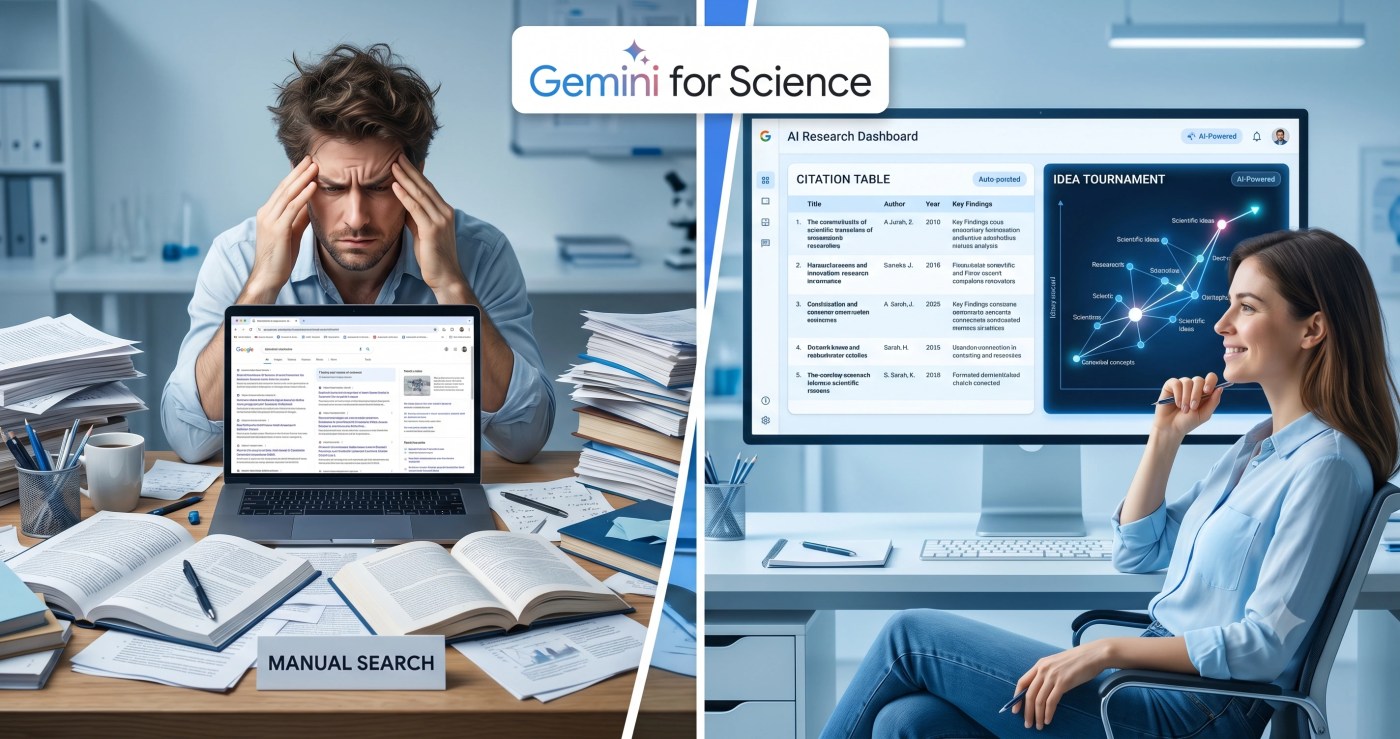
Picture the part of research nobody puts in the highlight reel. A scientist with a real question spends the next three weeks reading. Hundreds of papers, half of them adjacent, most of them skimmed. Then comes the slow grind of shaping a hypothesis, the longer grind of writing code to test it, and the quiet dread that someone in Seoul or São Paulo already answered this two years ago in a journal you never opened.
On May 19, 2026, at Google I/O, Google pointed a set of agents straight at that grind.
It is called Gemini for Science, and the consumer-facing piece lives at labs.google/science. Three experimental tools, each aimed at a different bottleneck in how discovery actually happens.
Here is the hook most coverage buried: Google is not betting on one giant model that knows biology. It is betting on general agents that can do the boring, time-eating parts of any field, so the human can spend their hours on the part only a human can do.
Let’s break it down.
What Google actually shipped
Gemini for Science is not a single app you download. It is a collection of experiments and tools, and it splits into two halves.
The first half is three prototypes on Google Labs that you can register interest in today. Access is opening gradually, not all at once.
The second half is the enterprise and power-user layer: a bundle called Science Skills that runs inside Google Antigravity, plus Google Cloud versions already in private preview with named companies.
The framing from Google’s own leadership is worth repeating. The authors of the announcement, Pushmeet Kohli of Google DeepMind and Yossi Matias of Google Research, describe today’s problem as a paradox: human knowledge is growing so fast that no single scientist can see the whole picture anymore. The tools are built to close that gap, not to take the wheel.
The three tools, in plain English
Forget the marketing names for a second. Each tool maps to a stage of research you already recognise.
1. Literature Insights, built with NotebookLM
This is the reading machine. You feed it a topic, and it searches scientific literature, then structures the results into a table with custom, searchable columns so you can compare papers side by side. Instead of fifteen browser tabs, you get one grid.
What this really means is you can walk into an adjacent field without drowning. The tool synthesises findings across papers, points at the gaps nobody has filled yet, and turns the whole thing into something shareable. Reports, slide decks, infographics, even audio and video overviews, all generated from your curated stack of sources, all with citations that link a claim back to the exact line in the source.
2. Hypothesis Generation, built with Co-Scientist
This is the brainstorming partner that argues with itself. You define a research challenge in plain language, and a multi-agent system runs what Google calls an idea tournament: agents generate hypotheses, debate them, critique them, and rank them against each other.
One agent acts as a virtual peer reviewer, picking holes in weak ideas before you waste a month on them. Every surviving claim is checked and backed by clickable citations, so you are not chasing a confident hallucination down a rabbit hole.
3. Computational Discovery, built with AlphaEvolve and ERA
This is the tireless lab assistant for code. Most experiments are limited by how many variations a human can realistically write and test. Computational Discovery is an agentic engine that generates and scores thousands of code variations in parallel, then shows you which ones actually moved your target metric.
Google points to fields like solar forecasting and epidemiology, where testing novel modeling approaches by hand would eat months. You can also inspect the lineage of the code to understand exactly where a jump in performance came from, which matters when you have to defend the result later.
The story that proves this isn’t just a demo
Here’s the thing about science tools: most of them look great in a launch video and fall apart in a real lab. So the question is whether the underlying tech has done anything verifiable.
It has. In early 2025, scientists at Imperial College London handed Co-Scientist a question they had quietly spent a decade answering: how certain superbugs pick up the ability to spread antibiotic resistance across bacterial species. Their findings were not published anywhere. Two days later, the AI’s top suggestion matched their unpublished conclusion almost exactly, and it threw in extra plausible hypotheses they had never considered.
Professor José Penadés, who led the work, was rattled enough that he emailed Google to ask whether the company had somehow accessed his computer. It had not. The team’s verdict was blunt: roughly ten years of research, compressed into a 48-hour head start.
His framing is the part to hold onto. As he put it, this is not about replacing scientists. It is about a tool that helps them work smarter and faster. The AI gave the hypothesis. Humans still had to run the experiments that proved it, and those took years.
That gap is the whole point, and we will come back to it.
The bigger swing: Science Skills and a scientific workbench
Alongside the three Labs tools, Google launched Science Skills, a bundle that wires more than 30 major life-science databases and tools into one place. That includes heavyweights like UniProt, the AlphaFold Database, the AlphaGenome API, and InterPro.
Run those skills on an agentic platform like Google Antigravity and you turn a code editor into a working scientific bench. Workflows like structural bioinformatics or genomic analysis, which normally take hours of manual stitching, collapse into minutes.
Google says its own team used Science Skills to run an analysis that usually takes hours in a fraction of the time, and that it surfaced fresh insight into a rare genetic disease linked to mutations in the AK2 gene. One internal example, so treat it as a signpost rather than gospel, but it tells you where this is pointed.
Who is already using it
This is not a closed demo with no users. The enterprise layer is in private preview with a real roster.
- BASF is using AlphaEvolve to optimise supply-chain decisions at scale.
- Klarna is using it to speed up its machine-learning models.
- Daiichi Sankyo and Bayer Crop Science are running Co-Scientist to accelerate research.
- The U.S. National Labs are using Co-Scientist as part of the Department of Energy’s Genesis Mission.
On the academic side, Google says it is working with more than 100 institutions to validate the systems, including Stanford on liver fibrosis and Imperial College London on antimicrobial resistance. Two underlying research papers, on ERA and Co-Scientist, were published in Nature on launch day, which is a meaningful signal that this is not pure marketing.
How to get access (step-by-step)
The Labs tools are rolling out gradually, so the honest first step is to get in the queue. Here is the exact path.
Step 1: Go to the Science page. Open labs.google/science in your browser. You will see the three experiments laid out with short demo videos.
Step 2: Express interest. Click the Express Interest button and submit your details. Access opens in waves, so the sooner you register, the sooner you are likely to get pulled in.
Step 3: Pick the tool that matches your stage. Reviewing a new field? Start with Literature Insights. Stuck on what to test next? Hypothesis Generation. Sitting on a modeling problem with a clear metric to optimise? Computational Discovery.
Step 4: Try Literature Insights through NotebookLM first. While you wait on the experiments, you can get a feel for the engine today inside NotebookLM, which already does grounded, citation-linked synthesis over sources you upload.
Step 5: If you need the heavy machinery, look at Antigravity. For genomics and bioinformatics workflows, explore the Science Skills use cases on Google Antigravity. This is the power-user lane, so give yourself a session to set it up properly.
Step 6: Always verify before you cite. Treat every generated hypothesis and every summary as a strong lead, not a finding. Click through to the source. The whole design assumes a human stays in the loop, and so should you.
The honest limitations
A tool this ambitious deserves a clear-eyed read. A few things to keep in mind before you reorganise your whole workflow around it.
- These are experiments, not finished products. Google calls them prototypes and is gating access for a reason. Expect rough edges and changing behaviour.
- It gives ideas, not proof. The Imperial superbug story is the perfect reminder. The AI matched a decade of thinking in two days, but the experiments that confirmed it still took years of human lab work. Generation is fast. Validation is not.
- Garbage corpus, garbage insight. Literature Insights is only as good as the papers you point it at. A narrow or biased source set produces a confident, narrow, biased summary.
- The best stuff is behind preview walls. The most impressive results so far come from enterprise partners and 100-plus institutions with deep support. A solo researcher’s day-one experience will be lighter than the headlines suggest.
- Peer review is watching closely. Google is piloting agentic peer-review tools with conferences like ICML and NeurIPS, which signals that the field itself is still working out how to handle AI-generated science responsibly. That conversation is not settled.
What I’d do this week
Four moves, in order, whether you are a researcher, a grad student, or just AI-curious.
- Register your interest at labs.google/science. Two minutes, and it gets you in the queue.
- Open NotebookLM and drop in five papers from your field. Ask it to build a comparison table and flag the gaps. This is the closest thing to Literature Insights you can use right now.
- Write down one research question you actually care about, phrased the way you would explain it to a smart colleague. That single sentence is the input every one of these tools needs, and getting it sharp is the real skill.
- Read the Co-Scientist paper in Nature or the official announcement. Knowing how the idea tournament works will make you far better at prompting it later.
If you do only one thing, do the NotebookLM exercise. Watching an AI build a clean literature table from your own messy stack of PDFs is the moment this stops being abstract and starts feeling like a tool you’ll actually open on a Tuesday.
That’s the headline.
If this made the future of research feel a little less intimidating, share it with the one person you know who is still buried under a stack of papers at midnight.
Sources and further reading
1. Google, Gemini for Science: AI experiments and tools for a new era of discovery (May 19, 2026).
2. Google DeepMind, Co-Scientist: A multi-agent AI partner to accelerate research.
3. Nature, Accelerating scientific discovery with Co-Scientist (2026).
4. Live Science, Google’s AI co-scientist cracked 10-year superbug problem in just 2 days.
5. Google Labs, Science experimental tools.
6. Google Cloud, AlphaEvolve on Google Cloud.


Leave a Reply