
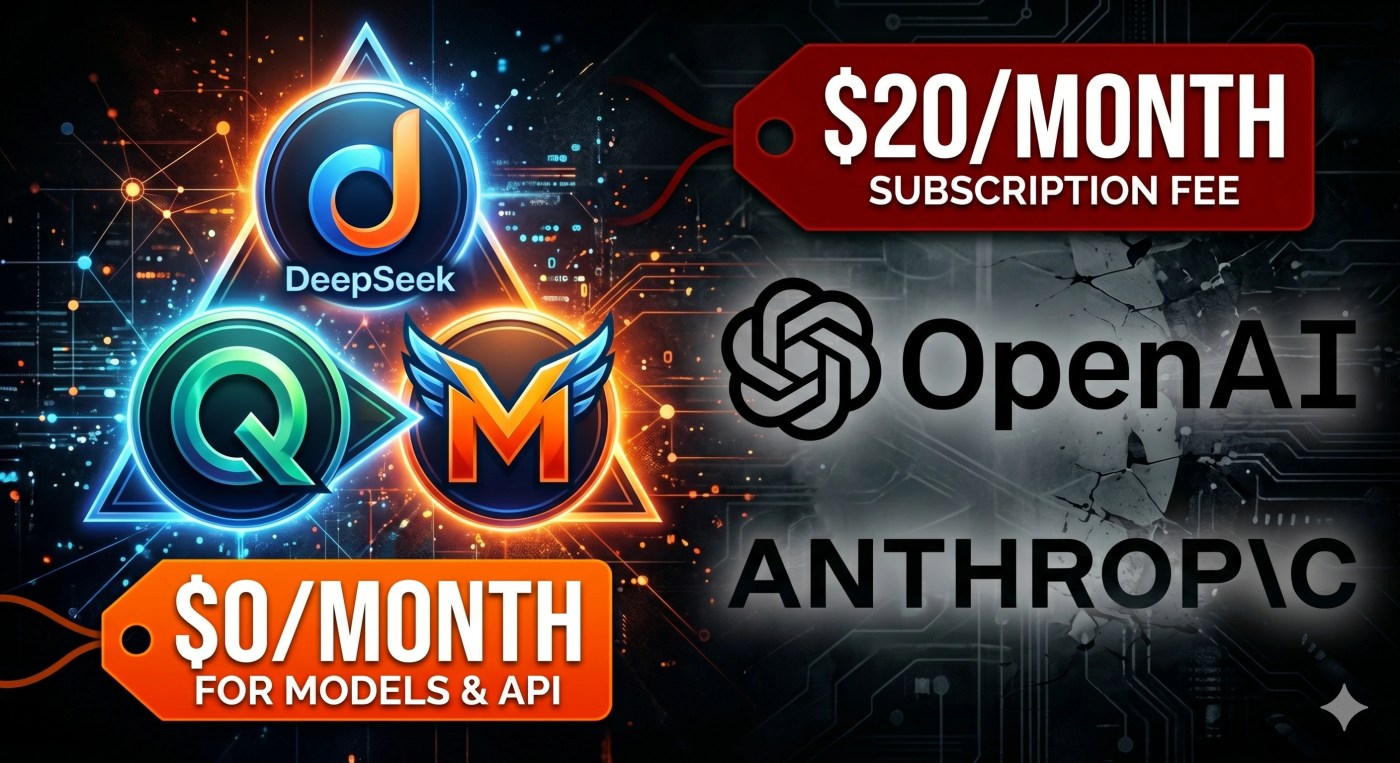
You’re paying $20 a month for ChatGPT or Claude. Meanwhile, three free models are matching them on most real tasks. Here’s what’s actually on the other side of the paywall.
Pull up your last credit card statement. If you use AI seriously, there is probably a quiet ₹1,700-ish charge ($20) sitting there for ChatGPT Plus or Claude Pro. Maybe both. Maybe Perplexity Pro on top of that. Add them up and you are spending the price of a decent dinner out, every month, on what is on most days just smarter autocomplete.
The pitch made sense in 2024. It mostly made sense even in early 2025. The frontier paid models were genuinely a generation ahead of anything free.
That gap has closed faster than the subscription industry would like you to notice.
I have been watching the AI tools space closely on Just Being Resourceful for a while now, and the second half of 2025 and the start of 2026 changed the calculus in a way that I think most users are not yet aware of. Three models in particular have done most of the closing, and they cost nothing.
DeepSeek V4 from China dropped in April 2026 and now sits 0.2 points behind Claude Opus on the headline coding benchmark. Qwen 3.5 from Alibaba speaks 201 languages, including every major Indian language, with quality that embarrasses Western models on Tamil, Telugu, and Marathi. Mistral Le Chat out of Paris answers at something like 1,000 words per second and stores your data on European servers, under GDPR.
None of them are perfect. None of them fully replaces GPT-5.5 or Claude Opus 4.7 if you live inside those tools all day. But for roughly 70% of what you actually ask an AI to do, the free option is now within a hair of the paid one. In a few specific tasks, the free option is actually better.
Here is what each one does well, where each one falls short, and how to decide what you actually need to keep paying for.
What changed in 2026
The shift was not one release. It was three things happening at once.
Open weights got serious. When DeepSeek released V4 under MIT and Alibaba released Qwen 3.5 under Apache 2.0, they did not just open-source a research model. These are flagship-tier systems. DeepSeek V4-Pro is a 1.6 trillion parameter mixture-of-experts model. Qwen 3.5-397B-A17B is 397 billion parameters. You can pull both from Hugging Face right now, run them on your own hardware if you have the GPU budget, and modify them for commercial use without paying anyone.
Architecture stopped being a moat. The old story was “they have a secret training recipe.” That is mostly not true anymore. DeepSeek V4’s CSA+HCA hybrid attention reduces memory usage to roughly 10% of the previous generation at one-million-token context. Qwen 3.5 was trained natively multimodal from the start instead of having a vision encoder bolted on later. These are real engineering ideas, not catch-up.
The benchmarks stopped reading like a one-sided story. On SWE-bench Verified, the standard test for real software engineering work, DeepSeek V4-Pro scores 80.6%. Claude Opus 4.6 scores 80.8%. That gap is not meaningful. On Codeforces competitive programming, V4-Pro actually beats GPT-5.4 with a rating of 3,206. These numbers were unthinkable two years ago for a free, open-weight model.
So what does each one feel like to actually use?
DeepSeek V4: The free model that codes like Claude
Access: Go to chat.deepseek.com. Sign up. That is the whole onboarding. The free web interface is fast and the limits are generous. Developers can hit the API, and anyone with serious hardware can download the open weights.
What it does best: Code. Math. Long-context reasoning. That is the trio.
V4-Pro hit a Codeforces rating of 3,206 at launch, the highest competitive programming score any model has ever posted, and ahead of GPT-5.4 at 3,168. On LiveCodeBench it scored 93.5, again at the top. On SWE-bench Verified, the gap to Claude Opus 4.6 is 0.2 percentage points. These are not “good for an open model” numbers. These are state-of-the-art numbers, period. The one caveat worth noting: Anthropic’s newer SWE-Bench Pro benchmark does show Claude Opus 4.7 holding a clearer lead, and DeepSeek has not yet published a comparable score for V4 on that test.
The one-million-token context window matters more than people realize. You can drop an entire codebase into one conversation and ask V4 to find the bug that has been driving you mad for two weeks. The CSA+HCA attention mechanism keeps memory and compute costs sane at that length, which means you actually get long context without watching the model slow to a crawl.
Where it falls short: General world knowledge and writing voice. On the harder reasoning benchmarks, Claude still has a small edge. On creative or persuasive writing, Claude reads more human. DeepSeek’s prose is technically correct and slightly flat — fine for a memo, less great for a wedding toast.
There are also the geopolitical caveats. DeepSeek is a Chinese company, and the hosted version has well-documented topic restrictions on Chinese political subjects. Ask it about Tiananmen or Xinjiang and you will get redirected or refused. The open-weight version you run yourself does not have those guardrails, but most readers will not be running 800 GB of weights on their laptop. For everyday work this matters less than people assume. For journalism or China-focused research, it matters a lot.
Reliability for everyday work: High. The model rarely refuses normal requests, handles long documents better than the paid frontier models in some cases, and the free interface is fast enough that you forget what you are not paying for.
Qwen 3.5: The free model built for the rest of the world
Access: chat.qwen.ai. Free, no signup wall worth worrying about. Weights are on Hugging Face. Worth noting that Alibaba has since released a Qwen 3.6 family in March–April 2026 with the same Apache 2.0 spirit, but the 3.5 release is still the cleanest open-weight flagship and the version most users will land on first.
What it does best: Anything multilingual. Anything non-English. This is where the model genuinely separates itself from the pack.
The headline number is 201 languages. The more important number is the tokenizer — Qwen 3.5 expanded to 250,000 tokens, up from 150,000 in earlier versions. For Latin-script languages this is a small efficiency gain. For Devanagari, Tamil script, Bengali, or Arabic, it cuts token usage by 10–60% depending on the language. This is not a vanity stat. It means Hindi text uses significantly fewer tokens to express the same thing, responses come faster, costs are lower if you are building on top of the API, and the model can hold much longer Indian-language documents in context.
If you are an Indian user, this is the single biggest practical AI development of 2026 and almost no one is talking about it. ChatGPT and Claude both handle Hindi reasonably well, but their performance falls off a cliff for Tamil, Telugu, Marathi, Gujarati, Kannada, Malayalam, Odia, Assamese. Qwen 3.5 does not. It handles every major Indian language with quality that, in side-by-side tests, matches or exceeds dedicated translation services. For anyone in this country building products, writing content, or doing customer service in regional languages, this is a much bigger deal than the AI Twitter feeds suggest.
The model is also natively multimodal — trained from scratch on text, images, and video together, rather than having vision grafted on. In practice this means it is noticeably stronger at reading screenshots of UI in non-English scripts, interpreting technical diagrams with mixed-script labels, and working through documents that combine images and prose.
Where it falls short: Pure coding and frontier reasoning. Qwen 3.5 is competitive with GPT-5.2 and Claude Opus 4.5 on general benchmarks but does not lead anywhere specific. For hard coding tasks, DeepSeek V4 is meaningfully better. For long-form English creative writing, Claude is still ahead. The model does not reason through extended chain-of-thought as fluidly as the dedicated reasoning models from OpenAI and Anthropic either.
Reliability for everyday work: Very high, especially for non-English work. The hosted chat interface is generous with limits, and the model is unusually willing to handle long, complex prompts in mixed languages without breaking.
Mistral Le Chat: The free model that respects your privacy
Access: chat.mistral.ai, or the iOS and Android apps. The free tier has daily message limits but covers most things you would actually do. Pro is $14.99 a month, which is notably cheaper than ChatGPT Plus or Claude Pro.
What it does best: Speed, privacy, and EU data residency.
Le Chat’s “Flash Answers” feature delivers responses at up to 1,000 words per second. In practice this means the response appears so fast you cannot read it as it streams; it just appears. For research tasks where you are iterating quickly through dozens of small questions, this compounds in a way that is genuinely useful. ChatGPT and Claude both feel slow afterward.
The privacy story is the structural one. Mistral is French. Servers are in Paris. The company is bound by GDPR rather than US data law. Le Chat Pro includes a No Telemetry Mode that switches off all usage logging. For European businesses in regulated industries, such as finance, healthcare, government, this is not a marketing point. It is a compliance requirement. For Indian businesses thinking ahead about the Digital Personal Data Protection Act and where their AI vendor’s servers physically live, Le Chat is the cleanest answer of the big chatbots.
The free tier is more capable than you would expect: code interpreter, document uploads with strong OCR, image generation through Black Forest Labs’ Flux model, and web search grounded in AFP and other journalism sources rather than the open chaos of search results.
Where it falls short: Raw model capability. Mistral’s flagship models are good, but they are not best-in-class on most benchmarks. For complex multi-step reasoning, GPT-5.5 Thinking or Claude Opus 4.7 outperforms Le Chat noticeably. The free tier also does not include Mistral’s strongest models, which sit behind the Pro paywall.
Reliability for everyday work: High for general tasks, especially anything privacy-sensitive. The speed alone changes how the tool feels.
Three real tasks, three models
The honest assessment of what each model does well on three things people actually use AI for. Drawn from benchmark performance and consistent reviewer experience rather than one staged demo. Run the tests yourself before making any switching decision.
Task 1: Write a professional email
Best paid result: Claude Opus 4.7. The prose is more natural, the tone matching is more accurate, and it holds nuance better than GPT.
Best free result: Mistral Le Chat. French AI labs have always punched above their weight on European-business-style formal writing, and Le Chat’s output is genuinely good. DeepSeek will produce something correct but slightly stiff. Qwen 3.5 is fine in English but truly excellent if you are writing the email in an Indian language.
Verdict: For an English email, Le Chat is within striking distance of Claude. For a Marathi or Tamil email, Qwen is in a different league.
Task 2: Summarize a long PDF
Best paid result: Claude Opus 4.7, by a small margin. Strong long-context performance and a habit of holding the document’s structure when summarizing.
Best free result: DeepSeek V4, especially for technical or analytical PDFs. The one-million-token context window means a 200-page report fits in a single conversation without truncation, and the model handles dense material well. Le Chat is also strong here — its document understanding and OCR for scanned PDFs is among the best in the industry.
Verdict: For most PDFs you would actually summarize, such as research reports, board decks, legal documents, DeepSeek V4 matches the paid frontier and gives you more room to work.
Task 3: Code a simple Python script
Best paid result: Claude Opus 4.7. The narrow lead on real-world coding benchmarks is real.
Best free result: DeepSeek V4, with no asterisk. The benchmark gap to Claude is 0.2 percentage points on SWE-bench Verified, and V4 actually leads on LiveCodeBench. For a simple Python script — read a CSV, transform some data, output a chart — you will not be able to tell the difference between V4 and Opus.
Verdict: If you are paying $20 a month for Claude purely for code, run a week of work through DeepSeek V4 before your next renewal. Most people will not switch back.
The bigger picture: why this actually matters
Three things worth saying clearly.
Open weights are a structural shift, not a marketing line. When DeepSeek released V4 under MIT and Alibaba released Qwen 3.5 under Apache 2.0, they did not just give away models. They removed the assumption that frontier AI has to live behind an American API. Any country, any company, any researcher can now host these models themselves. That changes the geopolitics of AI infrastructure in ways we are only starting to think through.
For Indian users, this is the moment to pay attention. Qwen 3.5’s Indian language support is the first time a frontier-class model has treated Indian languages as first-class citizens rather than afterthoughts. Combined with self-hostable open weights, this means Indian developers can build AI products for Indian users without paying token tax to American providers and without compromising on language quality. There is a parallel story for the Global South more broadly Yoruba, Swahili, Khmer, and Burmese, but for us, the opportunity is the largest by population.
Data privacy is finally a real choice. If you do not want your conversations going to American servers, you have actual alternatives now. Mistral keeps your data in Paris under GDPR. DeepSeek and Qwen, if you self-host the weights, keep your data on your own hardware. None of this was practically true a year ago. With the DPDP Act coming into force, this is the question every Indian business should be asking before its next AI procurement decision.
When to keep paying, when to stop
Here is the honest decision tree.
Keep paying for ChatGPT or Claude if:
- You use voice mode, image generation, or video tools daily. The free models do not compete here.
- You need the absolute best at long-form English writing and you can tell the difference. Claude still wins this.
- Your work involves complex agentic workflows such as multi-step browser automation, computer use, long-running coding agents. The paid tools have a real lead.
- You routinely hit usage caps. Free tiers still have limits.
Switch to free for most everything else if:
- Your main use is writing emails, summarizing documents, simple coding, research, and Q&A. The free models are within 5% of the paid ones on these.
- You work in non-English languages, especially Indian languages or other underserved scripts. Qwen 3.5 is the right answer.
- You care about data privacy or EU data residency. Le Chat is the right answer.
- You do heavy coding and do not need a $200 a month Max tier. DeepSeek V4 is the right answer.
The smart play for most people in 2026 is probably one paid subscription for whichever frontier model fits your most important workflow, plus active use of one or two free models for everything else. Not five subscriptions. Not zero subscriptions. One paid, two free, used deliberately.
The free AI ecosystem caught up while the subscription industry was charging like the gap still existed. The gap mostly does not. Cancel something this month and run the experiment yourself. Worst case, you re-subscribe. Best case, you save $240 a year and learn that the future of AI was never going to stay locked behind a paywall.
If you found this useful, Just Being Resourceful covers more on AI tools, prompting techniques, and India-specific AI angles. Comments and disagreements welcome, especially if you have actually run these models on work you care about.


Leave a Reply