
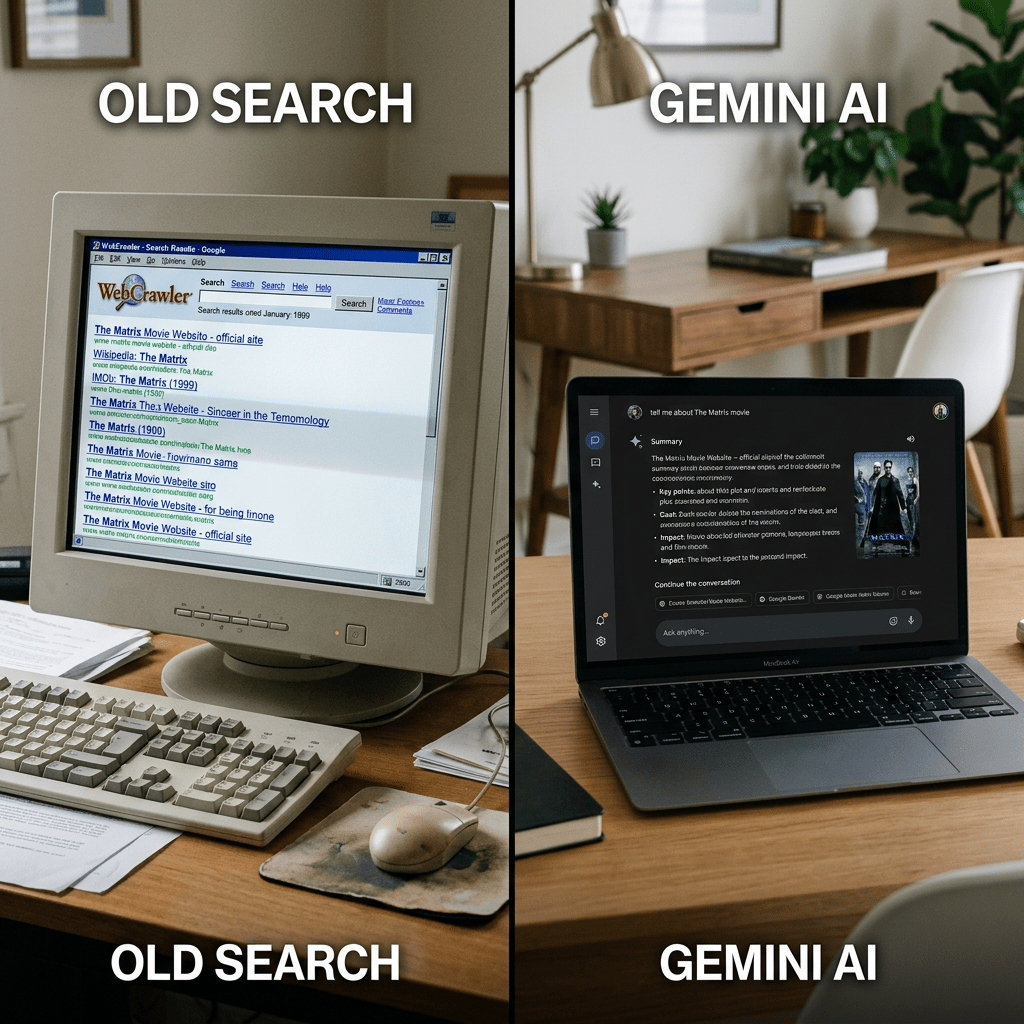
Open Google. Type your most expensive paid keyword. Look at what shows up before any blue link.
If your business has been on the internet for more than a decade, you just felt the floor shift.
That floor shifted six months ago, but it took until last month to settle into something stable, and most Indian businesses I speak to still think it is a UI tweak. It is not. Gemini 3, Google’s most capable model, now powers AI responses for almost every Google search you run, anywhere in the world. AI Mode generates simulations, calculators, and full visual layouts inside the results page. The intent of the searcher is being satisfied by Google itself, before any link is clicked.1, 2, 3
Your customers are not searching the way they did six months ago. Here is what changed and what to do about it this week.
The Three Dates That Quietly Rewrote Search
Most coverage treats this as one launch. It was three.
November 18, 2025. Google shipped Gemini 3 directly into AI Mode in Search on day one, the first time a new Gemini model has hit Search at launch. Initial access went to Google AI Pro and Ultra subscribers in the United States via a “Thinking” toggle.1
December 17, 2025. Gemini 3 Flash became the default model powering AI Mode in Search globally, replacing the older Flash class models that were running it. This is the change most people missed. AI Mode in 180+ countries is now Gemini 3 underneath.4
January 27, 2026. Google made Gemini 3 the new default for AI Overviews globally. AI Overviews already reach roughly 2 billion users every month. The follow-up question button now drops you straight into a conversation in AI Mode, on mobile, worldwide.2
That is the timeline. The “Thinking with 3 Pro” tier (for the hardest queries with full generative UI) is currently expanded across 120 countries for Pro and Ultra subscribers, India included.5
What Generative UI Actually Looks Like
Here is the part that breaks traditional SEO mental models.
When Gemini 3 decides your question is best answered visually, it does not look up a page that contains the answer. It builds the answer. In real time. As code.
Ask “show me how RNA polymerase works” and you do not get a list of biology blogs. You get an interactive simulation rendered inside the search result, with controls you can manipulate.6 Ask “compare a 20-year fixed mortgage versus a 30-year fixed at the current rate,” and Google generates a custom loan calculator on the page. You enter your numbers. You see the answer. You never click anywhere.1
Search Engine Land calls this “AI Mode becoming the default SERP experience.” Google’s own Head of Search has said the future of AI Mode is “full SERP integration.” The query, the comparison, the calculator, and the visualisation all collapse into a single response.3
Canvas, Google’s prototyping panel, also rolled into AI Mode in the U.S. on March 4, 2026. People can now describe an app or game inside the search bar and watch Gemini code it.7 This is no longer search in any classical sense.
What This Means for SEO and Content Marketing
Three numbers every marketer needs in their head this quarter:
- 42%. SE Ranking found that the move to Gemini 3 replaced about 42% of previously cited domains in AI search results. Almost half of who was getting cited got swapped out.8
- 32% more sources per response. Gemini 3 pulls from a wider pool than its predecessor, so traditional top-10 ranking is even less predictive of inclusion than before.8
- From 76% to 38%. Eight months earlier, 76% of pages cited in AI Overviews also ranked in the traditional top 10. Now it is 38%. Being highly ranked no longer guarantees being seen.8
Translation: the page you spent two years getting to position three is no longer doing the job you hired it for. Gemini 3 is picking sources based on entity authority, factual accuracy, multimodal asset quality, and how cleanly your content can be extracted, not on backlink count alone.9
This does not kill SEO. It elevates the bits of SEO that were always supposed to matter.
Why Indian SMBs Need to Move First
India is one of Google’s largest markets, with over 870 million internet users.10 AI Mode launched in India in June 2025, went fully public (no Labs sign-up) on July 8, 2025, and as of October 2025 supports Hindi, Bengali, Kannada, Malayalam, Marathi, Tamil, Telugu, and Urdu.11 If your customer is searching in any of those languages on a Pixel or any Android phone, they are already inside AI Mode whether they realise it or not.
For a chartered accountant in Pune, a boutique hotel in Goa, a SaaS startup in Bangalore, or a kirana chain in Lucknow, the practical question is no longer “where do I rank?” It is “when someone asks Google about my category, am I one of the brands the answer mentions?” If the answer is no, the rankings page does not matter.
That is the part most agencies are still pricing as a 2027 problem. It is a this-week problem.
Three Things Every Business Should Do This Week
1. Run Your Own AI Mode Audit (45 Minutes)
You cannot fix what you have not seen. Open Google in an incognito window. Run AI Mode on the ten queries that drive the most revenue for your business. Note three things for each search:
- What did the AI response say about your category?
- Which brands and sources did it cite?
- Where does your brand appear, if at all? First mention, third mention, not at all?
Do this for English. Then do it again in Hindi if your audience uses Hindi. Save the screenshots. This is your baseline.
2. Rewrite Your Top Three Pages as Direct Answers
Gemini 3 favours content that answers a specific question precisely and is structured for clean extraction. Pick the three pages that handle your most important commercial queries and rebuild each one with the following pattern:
- The question, stated explicitly, in the H1 or first H2. Use the question your customer actually types, not your internal jargon.
- A 40 to 60 word direct answer in the first paragraph. Treat this as the version Gemini will lift if it cites you. If it cannot survive being pulled out of context, rewrite it.
- Supporting evidence with named sources, dates, and numbers. Link out to credible primary sources. Cite specifics. AI models reward content that can be verified.
- FAQ schema on the page. Structured data still matters. Add FAQ schema for the secondary questions in your category.
This is not novel SEO advice. It is just no longer optional.
3. Build Entity Authority Signals This Quarter
Gemini 3 evaluates content authority “at the entity level,” not just at the domain level.9 That means consistency about who you are, across every place you appear, is now load-bearing.
- Use the exact same business name, founder names, and product names on your site, your Google Business Profile, your LinkedIn, your press mentions, and your Wikipedia page (if you have earned one).
- Add Organization, Person, and Product schema across the relevant pages.
- Pursue mentions on third-party sites that AI models trust: industry associations, recognised publications, Wikidata, and respected directories.
- Track how often AI assistants name your brand. Tools like Trackerly.ai or Profound do this for ChatGPT, Gemini, Perplexity, and Claude. (I covered Trackerly recently on this blog if you want a primer.)
None of these are quick wins. All of them compound.
The Honest Limitations
A few things to keep in perspective:
- “Thinking with 3 Pro” is paywalled. The full generative UI experience requires Google AI Pro or Ultra. The default Flash version, while fast, is less ambitious about what it generates.5
- AI Mode is still English-led globally. Indian language support exists but is newer and less mature than English.11
- Click-through rates from AI surfaces are lower than from blue links. Visitors who do click through, however, convert at meaningfully higher rates because they have already pre-qualified themselves through the conversation.9
- Google Search Console does not yet break out AI Mode and AI Overview traffic separately, so attributing exactly what is happening is harder than it should be.3
None of these change the direction of travel. They just mean the next twelve months will be messier than the headlines suggest.
The Bottom Line
Six months ago, the smart play was ranking on the first page. Today, the smart play is being the brand AI Mode mentions when your customer asks the question, in whatever shape that response takes (a paragraph, a table, a calculator, a simulation, or all four at once).
Run the audit. Rewrite the three pages. Start the entity work. None of this is glamorous. All of it is how you stay visible while everyone else is still arguing about whether AI search is real yet.
If your team still measures success by Google rankings alone, send them this. Then run the audit together.
Sources and further reading
- Google, Google Search with Gemini 3: Our most intelligent search yet (November 18, 2025).
- Google, Just ask anything: a seamless new Search experience (January 27, 2026).
- Search Engine Land, Google Search to route complex queries to Gemini 3.
- Search Engine Land, Google rolls out Gemini 3 Flash to AI Mode in Search globally (December 17, 2025).
- Google DeepMind, Gemini 3 model overview.
- Google Research, Generative UI: A rich, custom, visual interactive user experience for any prompt.
- TechCrunch, Google Search rolls out Gemini’s Canvas in AI Mode to all US users (March 4, 2026).
- Search Engine Land, 4 signals that now define visibility in AI search.
- Search Engine Land, Google AI Mode: What it is and how it impacts search.
- TechCrunch, Google introduces AI mode to users in India (June 23, 2025).
- TechCrunch, Google’s Search Live comes to India, AI Mode gets more languages (October 8, 2025).


Leave a Reply