
The Search Box You Have Used for 25 Years Just Quietly Died
Think about how you have searched for almost everything in your adult life. You guess a few keywords. You scan ten blue links. You click, hit a paywall, go back, refine your guess, and try again. That little white box rewarded people who learned to think like a machine.
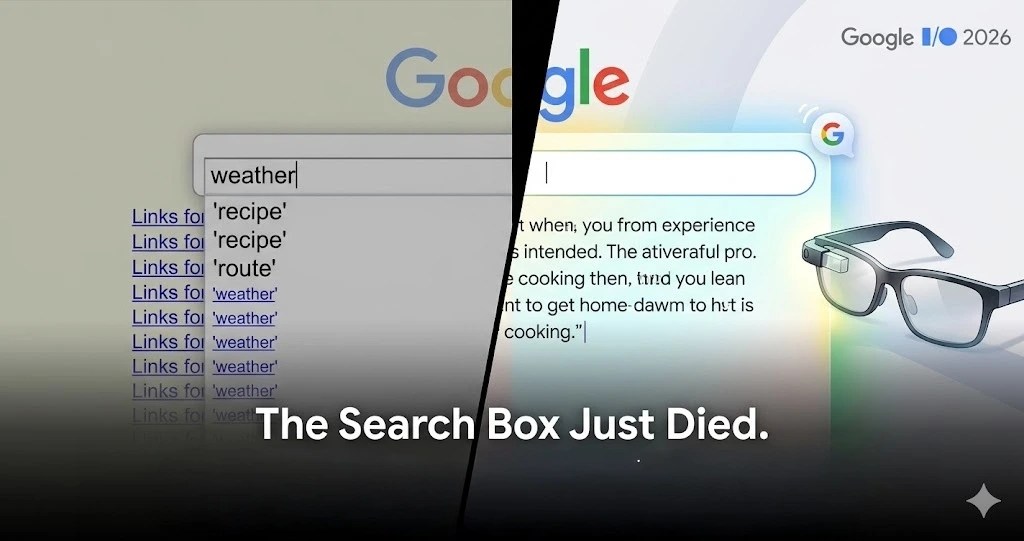
On May 19, 2026, at Google I/O, Google announced it is killing that ritual. Not the company, the ritual. The box that prints money for all of Alphabet is being rebuilt from the studs up, and Google is doing it on purpose, before a chatbot does it for them.
Here is the thing most headlines missed. This is not a redesign. It is an admission. Google is conceding that describing what you want in plain language beats guessing the magic keywords, and that the future of finding things looks a lot more like a conversation than a query.
Let’s break it down.
What Google actually announced
Google called it the biggest upgrade to the Search box in over 25 years. Nick Fox, the senior vice president for Search and Ads, went further in a pre-event interview and called it the biggest reinvention of the search box in 25 years, full stop.
The change is simple to describe and strange to absorb. The box now expands. You can type a long, messy, human question, the kind you would actually ask a knowledgeable friend, and it stretches to hold it. You can drop in text, images, files, videos, or even your open Chrome tabs as inputs. And instead of plain autocomplete, it now suggests ways to sharpen your question using AI.
This did not come out of nowhere. Google has been inching here for two years. It already pins AI-generated summaries at the top of results, and it built a chat-style experience called AI Mode. The number that matters: AI Mode crossed one billion monthly users in roughly a year, and Google says queries on it more than doubled every quarter since launch.
The new intelligent box started rolling out on announcement day, in every country and language where AI Mode is already live.
The real story: agents move into the search bar
The redesign is the part you will notice. The agents are the part that changes your week.
Until now, an agent lived inside a separate chatbot. You went to it. Google is flipping that. It is putting agents directly inside the search box, so you summon one just by asking a question. As DeepMind chief Demis Hassabis put it in his interview with Axios, “Agents in search is the next step.”
What does that actually do for a normal person? A few concrete examples.
Standing queries that watch the world for you. Instead of asking once whether your favorite band is touring, you set a query that quietly waits and pings you the moment any of those acts announce a show near you. Google calls these information agents, and the same idea works for recurring questions around shopping and news.
Agents that finish the task, not just find it. Reporting from I/O describes agents in Search that can complete purchases, check ticket availability, and manage schedules in real time, all powered by Gemini 3.5 inside AI Mode.
Hassabis framed why this matters from inside Google with refreshing bluntness. “One of the cool things we get to do here at Google is build technologies that get immediately deployed into multibillion-dollar products.” Translation: this is not a lab demo. It ships to billions of people the day it works.
Why Google is attacking its own cash cow
Here’s the part worth sitting with. Search is the single most profitable product in modern business history. It funded the maps, the email, the phones, the data centers, all of it. Alphabet posted $402.8 billion in total revenue in 2025, and Search drove most of it.
So why would anyone take a wrecking ball to that?
Because the alternative is worse. Standalone AI chatbots have spent two years teaching people that you can just ask, and get an answer, without ten links and a comparison-shopping side quest. Every minute a user spends in someone else’s chatbot is a minute not spent in Google’s ad-funded box. The existential math is simple: disrupt yourself, or watch someone else do it and keep the upside.
What this really means is that Google has decided the conversational interface wins, and it would rather cannibalize its own search traffic than lose the user entirely.
The bet is much bigger than search
Search is the headline, but the strategy underneath it is that AI escapes the chatbot and shows up everywhere you already are.
- Ask YouTube. You ask a how-to question and get both a written answer and the exact video that contains it. Search and video, fused.
- Gemini Spark. A personal assistant agent built into the Gemini app, designed to run a wider range of tasks for you. Google says it will eventually live inside the Chrome browser and other apps too, with users choosing whether to switch it on and which apps it can touch.
- Gemini 3.5 Flash. An updated model, tuned for coding and automated work, that went live the same week. Pichai said the more powerful 3.5 Pro arrives next month, and that Gemini now has 900 million monthly users across 230 countries.
AI is finally walking out of your screen
The most telling signal that Google believes this is the hardware. After the public flop of Google Glass over a decade ago, the company is back in the glasses game, and this time it has a reason to think it will land.
Meta already proved people will wear camera-and-voice glasses with its Ray-Ban line. Google’s pitch is that its AI and search depth let it leapfrog. Two distinct products were on display:
- Audio-first smart glasses, co-developed with Samsung and eyewear makers Warby Parker and Gentle Monster. No screen, mostly voice and Gemini. Google said the first model is expected around this autumn.
- Project Aura, the wearable built with Xreal that got its first real hands-on at I/O. Think of it as the in-between device: a far wider field of view than the audio glasses, but lighter than a full mixed-reality headset. It runs Android XR with Gemini and packs a 70-degree field of view, among the widest offered in AR glasses. Xreal confirmed a global launch before the end of 2026.
Hassabis summed up the whole hardware push in one line: “It’s a really exciting use case for where AI can get out into the real world.”
And then he said the quiet part: AGI by 2030
Asked about artificial general intelligence, Hassabis did not blink. His timeline is roughly what it has been for years: expect it around 2030, “maybe plus or minus one year.” He even reached for grander framing on stage, describing this moment as standing “in the foothills of the singularity.”
You can take that with as much salt as you like. The point is not the prophecy. The point is that the company rebuilding the world’s search box is doing so with that horizon in mind. The search redesign is not the destination. It is the on-ramp.
What this means for you, practically
Strip away the keynote drama and there are real changes coming to how you work, search, and get found. Here is what to do about it.
If you just want to use it better
- Stop typing keywords. Start typing sentences. The whole point of the new box is that it rewards detail. “Best laptop” is a worse query now than “quiet laptop under $900 with great battery for video calls and light editing.” Give it the context you would give a friend.
- Try AI Mode today. If you are in a country where it is live, open Google, switch to AI Mode, and ask a follow-up question instead of starting over. The conversation memory is the feature.
- Set one standing query. Pick something you check repeatedly, a price, a restock, an artist’s tour dates, and let an information agent watch it for you instead of refreshing a tab.
If you run a business or a website
- Assume fewer clicks, deeper intent. When the box answers directly, the people who do click through are further down the decision. Write content that wins that warmer visitor, not the casual skimmer.
- Get quotable. AI summaries pull from clear, well-structured, citable pages. Use plain headings, direct answers near the top, and specifics an AI can lift cleanly. Vague filler gets skipped.
- Audit your funnel for agents. If agents can complete a purchase or booking inside Search, your checkout, schema, and product data need to be machine-readable, not just human-pretty.
The honest caveats
Before you reorganize your life around this, a clear-eyed read.
- Rollout is uneven. The new box is launching where AI Mode already exists, which is not everywhere yet. Your mileage depends on your country and language.
- Agents that act carry real stakes. An agent that can buy things or manage your schedule is powerful and risky in equal measure. Read what you are authorizing, especially with Spark choosing which apps it can access.
- Hardware timelines slip. “This autumn” and “before end of 2026” are intentions, not guarantees. Google’s hardware track record is genuinely mixed, Glass being exhibit A.
- The ad model is unresolved. Nobody has fully answered how a conversational, agent-driven Search keeps making the money the old box made. Watch that space, because it shapes everything.
The bottom line
For 25 years, getting good at search meant getting good at guessing. That era just ended. Google is betting that the future belongs to people who simply describe what they want and let an agent go do it, and it is willing to blow up its own most valuable product to own that future first.
The smart move is not to panic. It is to start talking to your search box like it is finally listening. Because now it is.
If this reframed how you think about the most-used product on Earth, send it to the one person you know who still types three keywords and prays.
Sources and further reading
- Google, Google Search’s I/O 2026 updates: AI agents and the reimagined Search box (May 19, 2026).
- Axios, Google reinvents search before AI rivals replace it (May 20, 2026).
- Tech Wire Asia, Google I/O 2026 recap: AI agents, Gemini, smart glasses and more.
- Technology.org, Google I/O 2026: Cheaper AI, Agents in Search.
- Tom’s Guide, Google Search just got the biggest makeover in nearly 30 years.
- 9to5Google, Xreal’s Project Aura will launch before the end of 2026.
- Ubergizmo, Google and Xreal show Project Aura with a 70-degree field of view.


Leave a Reply