
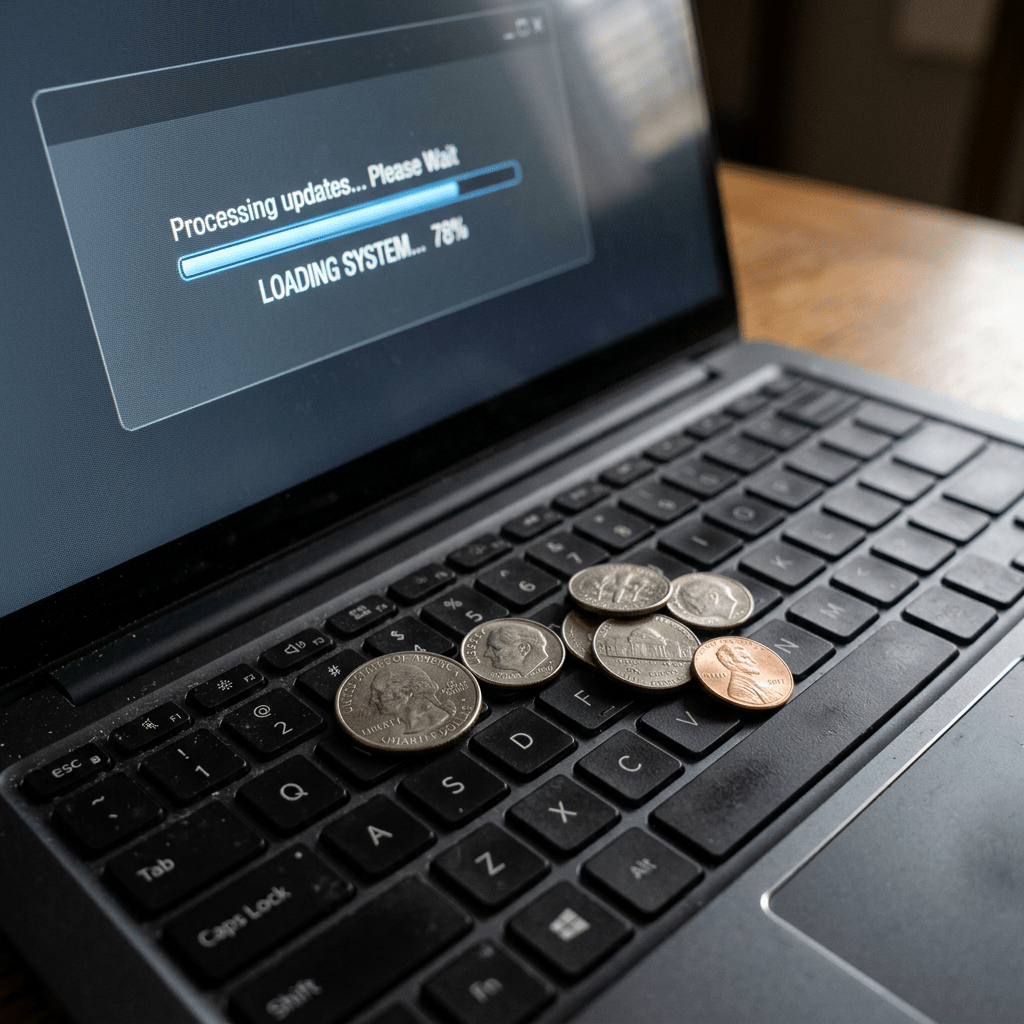
A developer turned Claude Code’s idle “Discombobulating…” spinner into an ad slot, and now pays you up to 70% of what advertisers bid for it. The early numbers are almost too small to believe, and that’s exactly why they’re worth seeing before you install anything.
Here’s the thing. Every time Claude Code or Codex is “thinking,” you’re staring at a throwaway line of text that does nothing for you. It just sits there while the model works. A developer named Andrew McCalip looked at that dead pixel and saw a billboard. He built a free VS Code extension called Kickbacks that auctions off that line to advertisers and pays you a cut of whatever they bid. The launch tweet pulled in millions of views in a day. Within 48 hours, two competitors showed up. People are genuinely earning money from this.
What they’re earning, though, is a different story from the pitch. Let’s break down what Kickbacks actually does, how to try it yourself, and what the real payouts look like once you get past the hype.
What Kickbacks Actually Does
When Claude Code or Codex is processing a request, it shows a random status verb while you wait: “Discombobulating…”, “Percolating…”, “Marinating…”. Kickbacks replaces that single line with a short, clickable sponsored message from an advertiser, the moment the extension is installed and you’re signed in.
That’s the entire product. It doesn’t touch your code, your prompts, or your chat history. It swaps one cosmetic UI element for another, and routes a slice of the ad revenue your way. It works inside VS Code, Cursor, Remote-SSH sessions, devcontainers, and code-server, and there’s a terminal CLI version too if you’re running Claude Code’s command line directly (you’ll need a recent build for that to work).
How the Money Actually Moves
Advertisers don’t pay per click by default here. They buy what Kickbacks calls a block, which is 1,000 five-second impressions of their sponsored line. They bid for it in an open, real-time auction, and the highest bid gets shown first. A click on the sponsored line counts as 50 impressions worth of value, so it’s far more lucrative for the advertiser to get a click than just an eyeball.
The minimum bid is $1 per block. That’s the number worth remembering, because it sets the floor for what you can possibly earn from any single ad shown on your machine.
Here’s where it gets a little messy, in a way that’s actually useful to know. At launch on June 11, Kickbacks paid developers 50% of ad revenue. One day later, the team rebuilt the entire marketplace and bumped the developer share to 70%, the number you’ll see quoted now. That’s not a small detail. A product changing its core payout structure within 24 hours of launch tells you exactly how new and unsettled this whole category still is.
| What happens | Unit | Your cut (at 70%) |
|---|---|---|
| Advertiser buys one block at the $1 minimum bid | 1,000 impressions | $0.70 total, split across 1,000 five-second views |
| Someone clicks the sponsored line | Counts as 50 impressions | Worth 50x a single impression’s share |
| You cash out | Minimum balance: $10 | Paid via Stripe Connect, self-serve |
Run the math on that floor price and you’ll see why this isn’t a side hustle yet. At a $1 block and a 70% share, you’d need roughly 1,400 five-second ad views, just to clear a single dollar. Bids do climb higher when advertisers compete for the top slot, but right now, most of the inventory is selling near that floor.
Step by Step: How to Try It Yourself
If you want to test it on your own machine, here’s the actual process.
- Open the VS Code Extensions panel and search for “Kickbacks.” Confirm you’re installing the genuine extension before clicking install. Several copycat extensions appeared within days of launch, so check the publisher name against the one listed on the official Kickbacks site before you trust anything.
- Install and reload the editor. If your company’s VS Code setup blocks Marketplace installs, the official site also offers a direct, signed VSIX download as a fallback.
- Sign in. Click “Kickbacks: Sign in” in the VS Code status bar and authenticate with your Google account. No survey, no card details, no crypto wallet.
- Keep coding normally. Every time Claude Code or Codex shows its thinking spinner, you’ll occasionally see a sponsored line instead. Your balance updates live in the status bar.
- Cash out once you cross $10. Connect Stripe from your Kickbacks dashboard and withdraw whenever your balance clears the minimum payout threshold.
One shortcut worth knowing: you can also hand the install instructions directly to Claude Code or another coding agent and let it run the commands for you, since the whole process is just downloading a signed file and running a single install command. If you’d rather not touch the terminal yourself, that’s the easier path.
The Honest Numbers: What People Are Actually Earning
This is the part the hype skips. Early adopters have been posting their actual earnings, and the spread is wide, but the totals are tiny across the board.
One early tester reportedly made around $1.30 in 20 minutes of active coding. Another logged a full day of normal work and walked away with 43 cents. Separate reports floating around developer forums land in a similar range: one person logged roughly 407 impressions over three hours for $4.43, another claimed $10 across two hours, and a different tester reported earning just 5 cents over 7 to 8 prompts. None of these numbers are wrong exactly, they’re just what happens when a brand new ad marketplace has a thin pool of advertisers bidding near the $1 floor.
McCalip himself has suggested that “at current rates,” the extension could eventually cover an entire AI subscription’s monthly cost, and floated a figure north of $1 per active coding hour as the market matures. That’s a forecast about where bids could go if enough advertisers show up and start competing for the top slot, not a description of what’s happening today. Treat it as an aspiration, not a fact you can bank on.
The Catch Nobody’s Advertising
Anthropic doesn’t run this, sponsor it, or officially support it. Kickbacks is a third-party extension that works by quietly patching the Claude Code VS Code bundle to inject its sponsored line, and reviewers who decompiled the extension found that it loosens the bundle’s Content Security Policy so its ad content can reach Kickbacks’ own server. That relaxed security setting reportedly stays active even if you simply disable the extension. It’s only removed if you fully uninstall it.
The extension also auto-updates from Kickbacks’ own infrastructure on a short interval, which is a normal thing for software to do, but worth knowing about given it sits inside the same editor you use for actual paid work. None of this means the extension is malicious. It means you’re handing a third party, however well-intentioned, a small amount of trust over a tool you rely on professionally, in exchange for cents a day right now.
The bigger context: at least two competing “wait state ad” extensions launched within 48 hours of Kickbacks going viral, each promising a similar or larger revenue share. None of them, Kickbacks included, has a long track record yet. This entire category is roughly two weeks old at the time of writing.
Where This Fits, and Where It Doesn’t
It’s worth trying if: you’re curious, you already use Claude Code or Codex daily, and you’re fine with a free, reversible experiment that might occasionally hand you a few cents while you work anyway.
Skip it if: you’re coding on a work laptop with strict security policies, you handle sensitive client code, or you were hoping this would meaningfully offset a paid AI subscription. At today’s bid prices, it won’t.
The Bottom Line
Kickbacks is a clever idea executed fast: turn dead screen time into an ad slot, and split the revenue with the person whose screen it occupies. The mechanics work exactly as advertised. The economics, for now, don’t add up to anything beyond pocket change, and the payout structure already changed once in the first 24 hours, which tells you this market is still finding its footing.
If you install it, install it for the experiment, not the income. The novelty is real. The subscription-paying side hustle isn’t here yet.
The most-watched line on your screen just got a price tag. Right now, that price tag reads about a nickel.
Sources
- Kickbacks.ai source repository and README, GitHub
- Kickbacks.dev, official marketplace and changelog
- Kickbacks.ai FAQ and fraud rules
- Kickbacks.ai Terms of Service, bidding and CPM mechanics
- Stork.ai, Kickbacks.ai Review (2026)
- DEV Community, comparison of AI wait-state ad platforms
- Go-to-Agency, code review and security analysis of the Kickbacks extension


Leave a Reply