
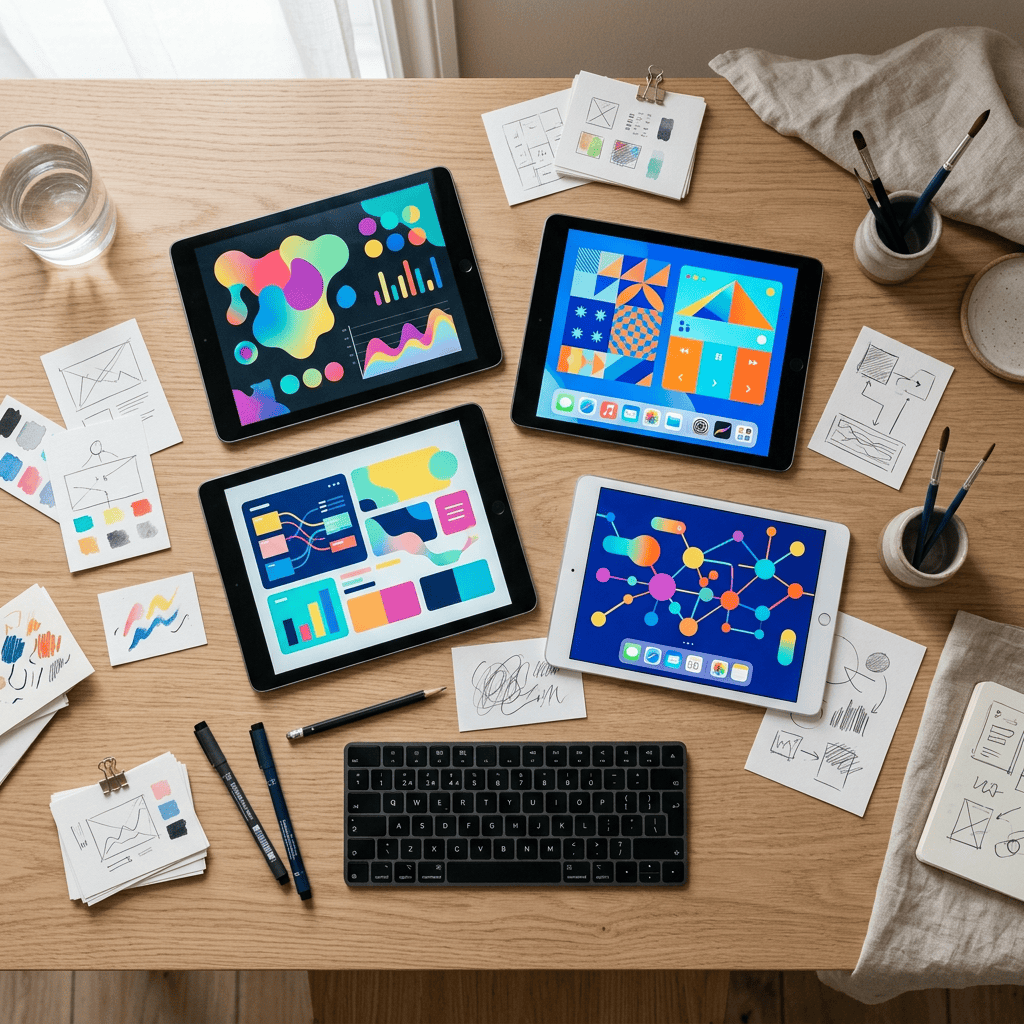
You’ve got four AI subscriptions open in four tabs, a client brief due in an hour, and no idea which model actually nails the brand tone you need. So you guess, pick one, and hope.
Design Arena exists to kill that guess. Feed it one prompt, and four AI models build their answer to it at the same time, names hidden, while you vote on which one actually gets it. It’s used by more than 5 million people across 190+ countries, and the company behind it just raised $7.9 million to do more of it.
Here’s what it actually does, how a session works, what it costs, and the one clause in the fine print that changes how you should use it.
What Design Arena Actually Does
Design Arena runs a blind tournament between AI models. You type a prompt, pick a category like Website, Logo, or Mobile App, and the platform samples four models from its active pool. They build in parallel, live, with their identities hidden. You vote through a short bracket, and only after your last vote do the model names get revealed.
A few things worth knowing before your first session:
- It’s genuinely free, not free-trial free. No plan unlocks more. You’re not really the customer here. The votes you cast are the product Design Arena sells to frontier AI labs looking for real human feedback at scale.
- The blind format is the whole point. Names stay hidden until after you vote, which removes the brand loyalty that quietly skews most “which AI is better” comparisons people run in their heads.
- It’s built for deciding, not shipping. There’s no code export, no CMS handoff, and per its own terms, no commercial use of anything you generate. More on that below, because it matters more than most reviews mention.
- It works best for people about to spend money on a subscription. Marketers, founders, and product teams who want a fast, honest read on which model fits a specific brief before committing budget to GPT, Claude, Gemini, or whatever else they’re eyeing.
- It’s the wrong tool if you want to walk away with a finished, editable file. For that you need a builder, not a benchmark, and we’ll get to a few of those.
The Company Behind It
Design Arena is built by a team that publicly operates as Intelligence, though its legal entity is registered as Arcada Labs Incorporated. The idea started a few weeks before graduation in 2025, when co-founder Grace Li and a handful of Harvard classmates were building their own AI game engine and ran into a problem no automated benchmark could solve: the games worked, but they weren’t fun. There was no metric for “fun,” or for taste in general, so they built one out of human votes instead.
That side project became Design Arena. Grace Li (CEO, Harvard Computer Science and Neuroscience) and Kamryn Ohly (CTO, Harvard Computer Science and Education, previously at Apple) run the company as a three-person team that went through Y Combinator before scaling fast.
The business model is the interesting part. Consumer use is free because consumers aren’t who pays. AI labs need scalable, honest human feedback to improve their design and coding models, and Design Arena’s blind votes are exactly that. According to the company, that data business is already generating $60 million in annual recurring revenue, and in August 2026 it closed a $7.9 million seed round led by Index Ventures, with Conviction, A*, and Valkyrie also participating. Those user and revenue figures come from the company itself, so treat them as a strong claim rather than an independently audited one, but the funding round and its backers are a matter of public record.
How a Battle Actually Works
Every prompt runs through the same structure:
- Prompt selection. You write a brief and pick (or let the system infer) a category.
- Model sampling. Four models get pulled from the active pool for that category.
- Parallel generation. All four build their response to your exact prompt at the same time.
- Bracket voting. You work through roughly five head-to-head picks: two opening duels, a winners’ match, a losers’ match, and a tiebreaker when it’s close.
- The reveal. Only after your final vote do the model names appear.
Every vote feeds a public leaderboard, ranked using the Bradley-Terry model, the same statistical family behind chess Elo ratings. There are more than two dozen individual leaderboards (Website, Mobile App, Logo, 3D Design, Data Visualization, Game Dev, and so on), and each one tracks Elo rating, win rate, sample size, and average generation time, which is worth watching closely since top models can range from under a minute to well over ten minutes per generation depending on the task.
One quick note on access: you don’t need an account to start a battle and cast your votes, but you do need to log in to actually view and keep your finished output. Budget an extra minute for that if you’re testing it for the first time.
Design Arena vs. a Single-Model AI Builder
| Design Arena | A Single-Model Builder (Lovable, v0, Bolt) | |
|---|---|---|
| Cost to try | Free, no account needed to vote | Free tier, paid plans from ~$20-25/month |
| What you get | A blind comparison across 4 models | One working, editable build |
| Output ownership | Retained by Design Arena per its terms | Yours, exportable to code or GitHub |
| Commercial use | Not permitted under current terms | Explicitly supported |
| Best for | Deciding which model to subscribe to | Actually shipping the thing |
How to Run Your First Battle
- Go to designarena.ai and pick a category. Website is the easiest starting point if this is your first session.
- Write a real brief, not a topic. “A landing page for a fintech app” gets you four generic, safe results. Add an audience, a mood, and one hard constraint (a specific CTA, a color rule, a layout requirement) and the four models start pulling apart from each other, which is what makes voting meaningful.
- Watch the builds happen live. All four generate at once, side by side, with no labels.
- Interact before you vote, don’t just look. For websites and UI components, scroll, click, and hover. A design that looks great in a screenshot but breaks on interaction should lose.
- Work through the bracket. Pick the better output in each head-to-head matchup until you reach a final ranking.
- Log in to see the reveal and keep your output. This is also when you find out which model actually won, which is often not the one you’d have guessed from its subscription price.
- Repeat with two or three of your real briefs before trusting a single result. One battle is an anecdote. A pattern across several of your own prompts is closer to a decision.
Pricing
Design Arena is free for individual use, full stop. There is no consumer subscription tier to unlock more generations or faster access. The company monetizes on the enterprise side, selling structured evaluation data and private benchmarking access to AI labs that want to know how their models actually perform against real human taste, not just automated scoring. There’s also a public API for pulling leaderboard data into your own dashboards or articles, which is free for personal and commercial projects as long as you attribute Design Arena and link back to the site.
The Honest Limitations
- Read the terms before you build anything you plan to keep. As of its June 2026 terms of service, using the platform “for any commercial purpose” is explicitly listed as a prohibited use, and a separate clause states that Arcada Labs (the operating entity) owns all rights to the output you generate, not you. This is the detail most write-ups skip entirely.
- Your prompts and uploads carry a broad license too. By submitting anything to the Services, you grant the company a perpetual, sublicensable right to use, modify, and commercialize it, including for training its own or partners’ models. If your prompt contains anything proprietary, keep it out.
- It’s not a production tool. No brand kits, no revision history, no direct export to your CMS or codebase. It shows you what a model can do; building the real thing happens inside that model’s own product.
- Human preference isn’t the same as correctness. A confidently wrong or broken build can still win a vote if it looks better at a glance, especially on prompts nobody bothers to click into.
- Rankings move constantly. Models rotate in and out of the pool, and a leaderboard snapshot from last week may already be stale. Treat single battles as anecdotes and only trust patterns across several of your own prompts.
- Not every category is fully live. Video generation is currently paused (“coming back soon” on the site), though historical video leaderboards are still viewable.
Who Should Actually Try This
If you’re a marketer, founder, or small team about to commit to a monthly AI subscription and you’re not sure which model actually fits your kind of work, run three or four of your real briefs through Design Arena before you pay for anything. Ten minutes of blind voting beats a month of subscription roulette.
If you’re evaluating models for a product decision at a larger company, the public leaderboards are a useful second opinion alongside your own internal testing, with the caveat that the sample skews toward whatever the broader user base happens to prompt for, not necessarily your niche.
If you need a finished, ownable, commercially usable file by the end of the session, skip straight to a builder instead. That’s not a knock on Design Arena, it’s just not what it’s for.
Alternative Tools
- Arena (formerly LMArena, rebranded in January 2026): the original blind-battle benchmark, spun out of UC Berkeley’s Chatbot Arena project. Free, no signup required, and broader than design alone, covering text, code, and image arenas. Pick this if you want to judge raw model reasoning and chat quality, not just visual output.
- Shuffle: runs the same “compare multiple AI models on one prompt” idea, but lets you keep and visually edit the winner afterward, then export clean code to Next.js, WordPress, Laravel, or plain HTML. Paid plans start around $24/month, with an annual option near $99/year and a $249 lifetime license.
- Lovable: skips comparison entirely and builds a real, working app with a database and deployment baked in. No voting, no bracket, just one model doing the work. Free tier available; Pro starts at $25/month for 100 credits.
The Bottom Line
Design Arena solves a real problem: everyone claims their AI model is the best at design, and nobody outside the labs has an honest way to check. The blind bracket format is a genuinely good idea, and running your own briefs through it before picking a subscription is ten minutes well spent. Just don’t confuse a taste test with a production tool. Vote in the arena, shortlist the models that keep winning your kind of brief, then go build the real thing inside whichever model earned it, or in a proper builder that lets you actually keep and ship what you make.
If you’ve ever picked an AI subscription based on a demo video instead of your own brief, this is the ten-minute habit that fixes that.
Sources and further reading
- Design Arena, Design Arena homepage.
- Design Arena, Methodology and about page.
- Design Arena, Terms of Service.
- TechCrunch, Design Arena creators raise $7.9 million to bring taste to AI models.
- Y Combinator, Design Arena company profile.
- Arena, LMArena is now Arena.
- Shuffle, AI Design Arena feature and pricing.


Leave a comment