
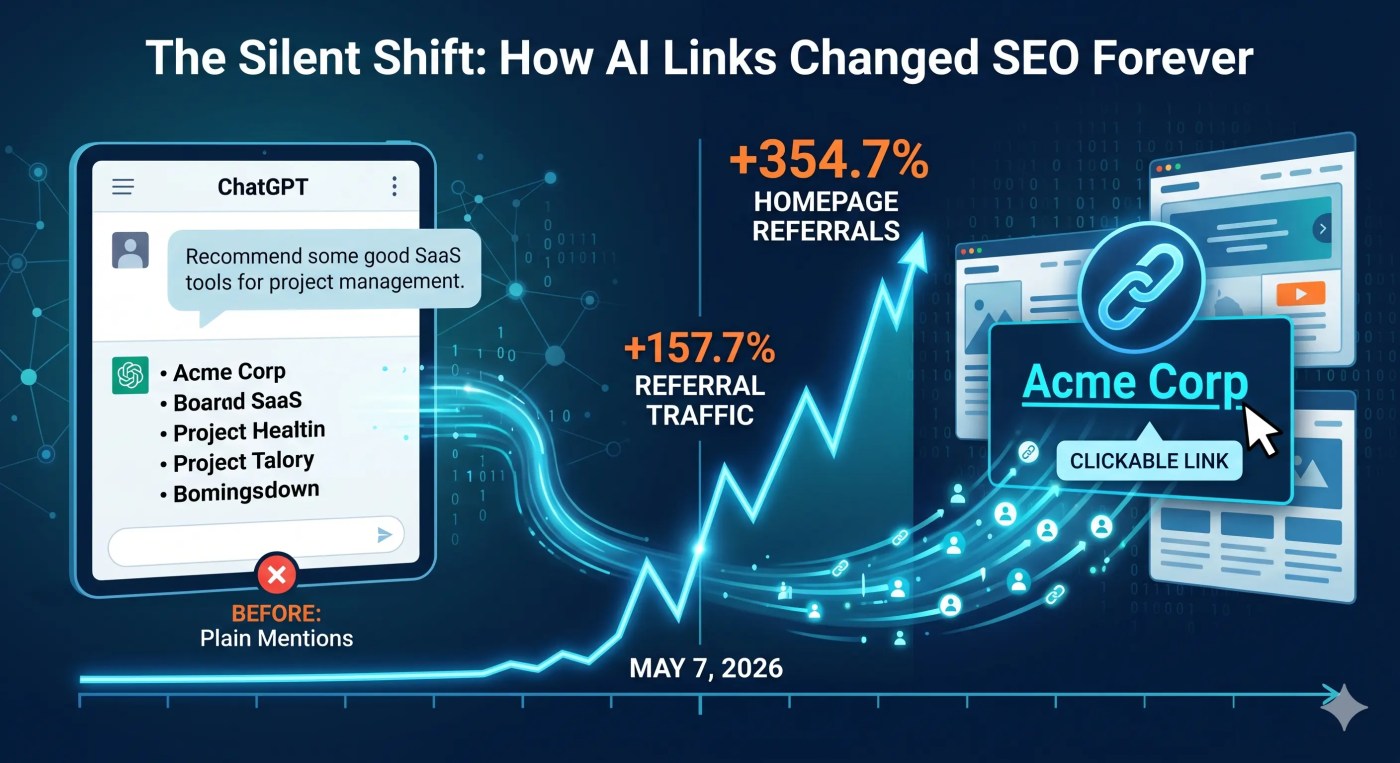
Something quiet happened on May 7, 2026. No announcement, no press release. ChatGPT just started doing something it had never done before: turning brand names into clickable links that go directly to a company’s homepage.
Within one week, referral traffic from ChatGPT to monitored brand websites jumped 157.7% week over week. Homepage referrals alone surged 354.7%. That is not a rounding error. That is a structural change in how AI sends people to websites.
Here is the thing. ChatGPT did not change who it recommends. It changed what happens after it recommends them. Before May 7, a ChatGPT answer naming your brand left users with nowhere to go. The brand was mentioned, maybe bolded, and that was it. After May 7, the same brand name became a live link routing users straight to your front door.
This matters whether you run a SaaS startup, a consultancy, an e-commerce brand, or a personal brand. The rules for how AI finds you and sends people to you just changed. And most businesses have not noticed yet.
What Actually Changed on May 7
Researchers at Profound, an AI visibility analytics platform, spotted it in their own traffic data first. Referrals to their site from ChatGPT jumped 200% overnight and stayed there. Their homepage’s share of those ChatGPT referrals went from roughly 28% of all AI-driven traffic to over 62% in a single day.
They checked across every brand site they monitored. Same pattern, everywhere.
What changed technically: Profound’s research found that the share of ChatGPT responses containing a brand URL jumped from roughly 4.5% to 20-24% on May 7, about a five-times increase, and it happened overnight. Qwairy, which analyzed over 140,000 ChatGPT answers collected between April and May 2026, found that the rate of answers linking to a brand’s own site jumped from 0.4% to 6.2%, roughly 14 times, on a single day.
Every link came tagged with a utm_source=chatgpt.com parameter, so brands with Google Analytics 4 set up could actually measure it. For the first time, ChatGPT referral traffic was attributable, visible, and real.
Similarweb’s data across tracked websites confirms the scale. Their analysis shows ChatGPT referral traffic converting at 7.1%, second only to paid search at 7.8%, and ahead of organic search, social, email, and display. The traffic is smaller in volume than Google organic. But the intent behind it is higher.
Why OpenAI Did This (The Part Nobody Is Talking About)
Profound’s research team flagged a detail that changes the strategic picture considerably.
May 7, 2026 was the same day OpenAI launched self-serve advertising to the general public.
That timing is almost certainly not a coincidence. When ChatGPT embeds brand URLs and measures which ones get clicked, it generates exactly the kind of click-through signal an ad ranking model needs. Which brands users actually want to visit, not just read about, becomes training data for which recommendations deserve prime placement.
What this really means is that organic brand links are, right now, functioning as signal collection for a future ad product. Brands getting organic clicks today are telling OpenAI something valuable about user intent. Pay attention to that.
Who Won, Who Did Not, and Why
The Branded Link Update did not treat all industries equally. Profound’s data shows the gains broke down roughly like this:
- B2B Software and SaaS: the biggest winner by far. Daily ChatGPT referrals up more than 200% from the pre-May 7 baseline.
- Financial Services and Fintech: a 60% lift, meaningful but more modest.
- E-commerce and Retail: essentially flat. No meaningful change.
The reason e-commerce did not move is instructive. ChatGPT routes retail product recommendations through a separate shopping surface, not the branded recommendation flow that received the hyperlink treatment. The pattern is clear: categories where ChatGPT recommends companies gained. Categories where ChatGPT recommends products did not.
If your business is one that gets recommended by name when someone asks an AI “what should I use for X,” you are in the category that just got a new traffic lever. If you sell physical products that get compared on spec and price, the dynamics are different and this particular update is less relevant for now.
This Is the GEO Story That Matters
GEO stands for Generative Engine Optimization. It is what SEO becomes when the search engine is an AI that synthesizes answers instead of listing links.
The core difference: traditional SEO gets you ranked in a list. GEO gets you cited inside an answer. And now, thanks to May 7, getting cited can also mean getting clicked.
Here is what we know about how ChatGPT decides who it cites and links to:
- Wikipedia leads with 6.2% of citations, Reddit follows at 5.2%, according to Similarweb’s citation analysis. This tells you that authoritative reference content and community credibility both matter.
- ChatGPT mentions brands 3.2 times more often than it links to them, even after the May 7 update. Mentions are still the primary form of AI visibility. Links are the upgrade.
- Only 2.8% of ChatGPT answers included citations as of August 2025, up from 0.6% in January 2025. The trajectory is upward, but the absolute numbers are still small. Most visibility still happens without a click.
- Content readability and domain rating both influence citation probability. ChatGPT appears to weight readable, well-structured content from domains with solid authority.
- Bing’s index is the gateway for ChatGPT’s web search mode. If you want to appear in live ChatGPT answers, you need to be indexed there.
What this creates is a two-tier game. Tier one is getting mentioned at all. Tier two is getting clicked. The May 7 update made tier two suddenly matter much more, and it happened with no warning.
How to Show Up in ChatGPT Answers: A Practical Checklist
These steps are ordered by what moves the needle fastest, based on what the research actually shows about how AI platforms select and cite sources.
Step 1: Check Your Current AI Visibility (Free, Takes 20 Minutes)
Before changing anything, know where you stand. Open ChatGPT, Perplexity, Gemini, and Claude. Type in the 10 questions your ideal customers are most likely to ask when looking for something you offer.
Write down: which brands appear in the answers, which sources get cited, and whether your name shows up anywhere. This is your baseline. Run it again in 60 days to measure progress.
Step 2: Submit Your Site to Bing Webmaster Tools
ChatGPT’s browsing mode and web search run on Bing’s index, not Google’s. Most site owners have never set this up.
- Go to Bing Webmaster Tools and sign in with a Microsoft account.
- Add your site and verify ownership via XML file, meta tag, or CNAME record, whichever your hosting allows.
- Submit your XML sitemap. In WordPress, this is typically at
yoursite.com/sitemap.xmlor generated by your SEO plugin (Yoast, Rank Math, or All in One SEO). - Use the URL Inspection tool to submit your most important pages for crawling.
This one step is the most commonly skipped and the most directly connected to ChatGPT visibility.
Step 3: Restructure Your Content So AI Can Actually Use It
AI engines retrieve content differently from how humans read it. They need answers near the top of the page, clear structure, and specific claims with supporting evidence.
For each of your most important pages:
- Add a TL;DR summary in the first 200 words that states your main point directly.
- Use question-and-answer sections with headers phrased as questions your customers actually type.
- Include data, statistics, and comparisons in tables where possible. AI models cite specific, citable facts more readily than vague claims.
- Make sure each page has a named author with a bio, a visible publication date, and an update date. E-E-A-T signals matter for both Google and AI citation likelihood.
Step 4: Build Brand Mentions Across the Web
AI platforms do not just read your own site. They read everything written about you across the internet and use that to decide how authoritative and relevant your brand is.
The priority actions:
- Pitch guest articles or expert commentary to industry publications your audience actually reads.
- Get quoted in roundups, comparisons, and listicles in your category. These are among the most-cited content formats in AI answers.
- Build a presence on Reddit by genuinely participating in subreddits relevant to your field. Reddit is the second most cited source in ChatGPT answers overall.
- If you have not already, get a solid Wikipedia mention or ensure any existing entries mentioning you are accurate. Wikipedia is the single most cited source in ChatGPT answers.
According to MuckRack analysis cited by COSEOM, approximately 95% of links cited by AI platforms come from non-paid coverage, with about 25% from journalistic sources. Earned media is not optional for GEO. It is the mechanism.
Step 5: Track ChatGPT Traffic in GA4
Since May 7, every link ChatGPT embeds carries a utm_source=chatgpt.com tag. This means you can now measure AI-driven traffic directly in Google Analytics 4.
- In GA4, go to Reports > Acquisition > Traffic Acquisition.
- Filter by Session source containing “chatgpt.com”.
- You will see referral sessions, pages visited, and conversion behavior from ChatGPT traffic specifically.
One important caveat: some ChatGPT traffic still arrives without the UTM tag, particularly from mobile app interactions, and can appear as direct traffic. The 157.7% week-over-week jump in attributed referrals is likely an undercount of total ChatGPT influence. But it is the measurable portion, and it is worth tracking.
The Bigger Picture: AI Is Already Your Brand Discovery Channel
Here is a number worth sitting with. 47% of B2B buyers now use AI for vendor research. Half of them start product research on ChatGPT instead of Google.
That buyer might never click through to your site from the AI answer. They might just remember your name, then search for you directly on Google later, or type your URL into their browser. The assisted conversion from AI exposure to eventual purchase is real, and it is hard to measure precisely because it crosses channels.
What this means practically: even when ChatGPT mentions your brand without linking to you, something happened. The buyer’s shortlist just got updated. Your name is now in their head. And when ChatGPT does link to you, as it increasingly does since May 7, that buyer arrives at your homepage having already received a recommendation. The conversion intent is pre-built.
That is the part that makes ChatGPT referral traffic convert at 7.1%, nearly on par with paid search. The AI already did the persuasion work. You are just closing the loop.
What to Do This Week
Three things that actually move the needle, in order of effort:
Today (15 minutes): Run your brand through ChatGPT, Perplexity, and Gemini with your top 10 customer questions. Screenshot everything. This is your starting point.
This week (1-2 hours): Submit your site to Bing Webmaster Tools and submit your sitemap if you have not already. Set up GA4 to filter traffic by chatgpt.com as a source. Now you can actually see what you are getting.
This month: Pick your three highest-traffic pages and rewrite the opening 200 words to lead with a direct answer. Add a TL;DR. Add one data table or comparison. Add visible author and date information. These structural changes make your content easier for AI to extract and cite.
GEO is still early enough that moving now gives you a real advantage. Frase’s GEO research points out that there is currently less competition in AI citation than in traditional SEO, and that citation authority compounds over time. Sources that get cited frequently get cited more. The early-mover gap is real.
The brands building that authority right now will be very hard to displace six months from now.
The companies that treat AI brand mentions as a vanity metric today are going to spend next year trying to reverse engineer why their competitors show up in every ChatGPT answer and they do not.

