
Meta is spending more on AI this year than the GDP of most countries. And that number just went up.
When Meta first announced its 2026 capital expenditure guidance, the figure was $115 to $135 billion. Then, after Q1 2026 earnings, it quietly raised that to $125 to $145 billion. The stock fell 6% overnight. Investors flinched. Zuckerberg didn’t.
Meanwhile, OpenAI told investors it expects to generate $100 billion in annual advertising revenue by 2030. Not total revenue. Advertising revenue alone. That’s Google-scale ambition, from a company that didn’t run a single ad two years ago.
Here’s the thing none of the individual product launch posts ever explain: every feature change, every pricing shift, and every new model you’re being asked to upgrade to is downstream of these numbers. The tools you use every day are being shaped by a financial arms race you probably didn’t know existed.
This is the post that connects those dots.
The Scale Is Hard to Comprehend, So Let’s Make It Concrete
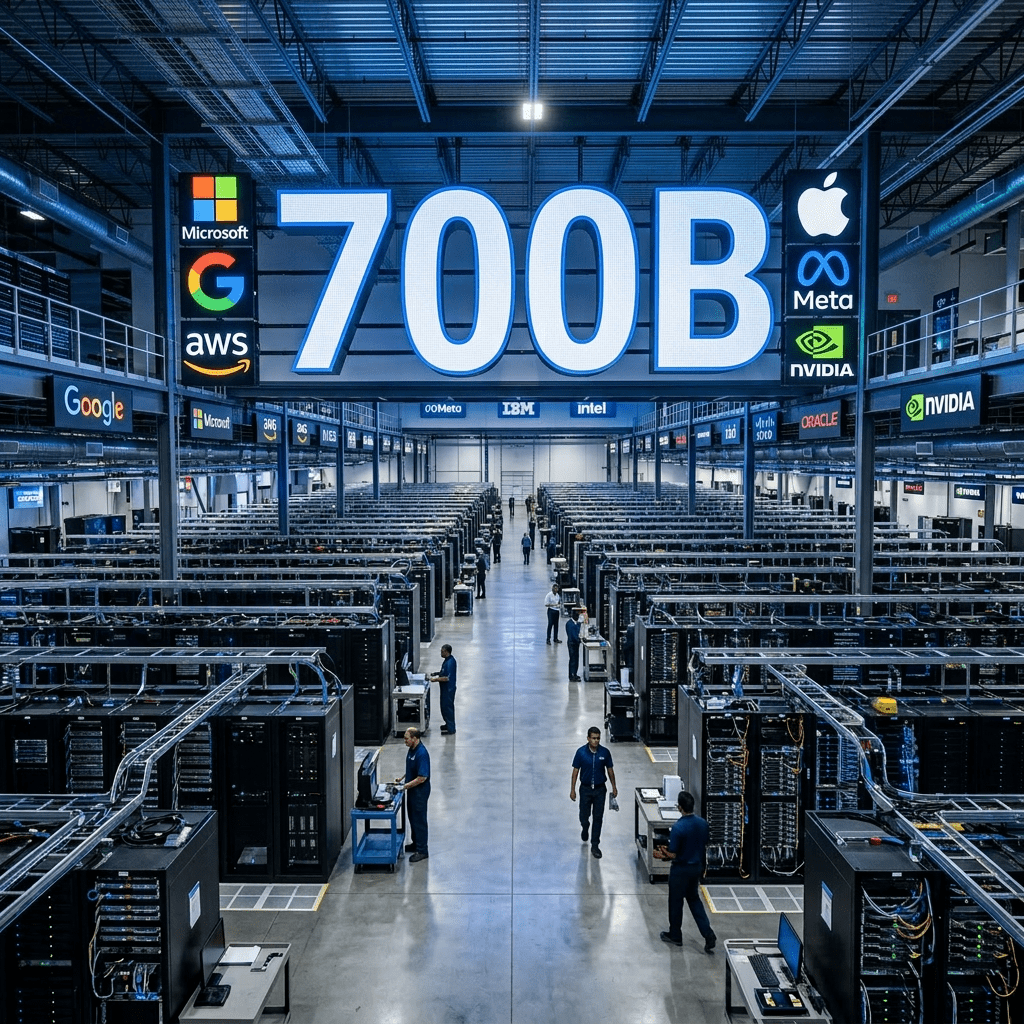
Four companies, Amazon, Alphabet (Google), Microsoft, and Meta, have committed to spending roughly $700 billion combined on capital expenditure in 2026. That’s nearly double what they spent in 2025.
To put that in perspective: the GDP of Saudi Arabia is about $1.1 trillion. These four tech companies are spending the equivalent of 64% of Saudi Arabia’s entire economy, in a single year, on infrastructure.
Break it down by company and it gets sharper:
- Amazon: $200 billion in projected 2026 capex, mostly for data centers
- Alphabet (Google): $175 to $185 billion, nearly double what it spent in 2025
- Meta: $125 to $145 billion, up from $72.2 billion in 2025
- Microsoft: $110 to $120 billion, with AI revenue already surpassing a $37 billion annual run rate
And that’s before you add OpenAI’s Stargate project, a $500 billion infrastructure commitment involving OpenAI, SoftBank, and Oracle.
What’s it all going toward? GPUs, yes, but also power. A rack of 8 Nvidia H100 GPUs draws 10 to 12 kilowatts continuously. A serious AI training cluster runs at 70 to 80 megawatts. That’s the power consumption of a small city, from one facility. Microsoft has signed nuclear energy contracts. Google is funding solar farms. Meta is building a gigawatt-scale data center campus in Louisiana through a $27 billion joint venture.
This is not software anymore. This is physical infrastructure at a scale that hasn’t been seen outside of national energy grids.
Why They’re Spending This Much
The short version: every company at the table has decided that whoever controls the most compute wins. And right now, they’re all supply-constrained, not demand-constrained. The bottleneck isn’t users. It’s servers.
But there’s a harder reason too. These companies have already made the bet. The data centers are under construction. The chip orders are in. The workforce has been restructured around AI priorities. Meta laid off 10% of its staff in May 2026, roughly 8,000 people, while simultaneously announcing it would hire aggressively in technical AI roles. You don’t spend $145 billion on infrastructure and then quietly walk it back. You spend it and then figure out how to make it pay.
That last sentence is the one that matters for you as a user.
What “Making It Pay” Actually Looks Like
Here’s what this spending has to recover, and what it means for the tools sitting in your browser tabs right now.
1. Ads Inside AI Tools Are No Longer a Rumor
OpenAI launched ads in ChatGPT for free and low-tier US users in early 2026. The company’s ad pilot generated $100 million in annualized revenue within six weeks. The target is $2.5 billion in ad revenue this year, $11 billion by 2027, $25 billion by 2028, $53 billion by 2029, and $100 billion by 2030.
Those numbers assume OpenAI’s products reach 2.75 billion weekly users by 2030. ChatGPT currently sits at around 900 million weekly active users. The gap between now and 2.75 billion gets closed through the free tier. The free tier gets monetized through ads. You are the product, unless you pay.
Google has done this forever. What’s new is that the AI conversation interface, which you might actually trust, is now the ad surface. When your AI assistant recommends a product or a restaurant, you’ll need to develop a new reflex: is this the best answer, or the sponsored one?
2. Subscription Prices Are Being Tested Upward
The $20 per month standard tier hasn’t moved yet across the major providers. ChatGPT Plus, Claude Pro, and Google AI Pro all hold at roughly $20 per month as of May 2026. But the top tiers have expanded dramatically.
OpenAI launched a $100 per month ChatGPT Pro tier. Anthropic has Claude Max at $100 and $200 per month. Google AI Ultra sits at $249.99 per month. Grok’s SuperGrok Heavy runs $300 per month.
Analysts are already predicting that ChatGPT Plus could rise to $25 to $30 per month by late 2026 or early 2027. The economics are straightforward: only about 5% of chatbot users pay anything right now. These companies need that number to rise significantly to justify the infrastructure they’ve already committed to building.
3. Free Tier Capabilities Are Being Managed Deliberately
This is the one that stings the most quietly. The free tier is not getting worse in any obvious way. It’s just getting strategically gated.
The best models stay behind paywalls. Rate limits tighten. New features land in paid tiers first, sometimes exclusively. Features that were once included get moved to higher plans. In April 2026, Anthropic pulled Claude Code access from the $20 Pro plan. GitHub froze new signups for Copilot Pro the next day. OpenAI had already moved certain capabilities to its $100 tier the week before.
None of those changes happened by accident, and none of them happened because the product got worse. They happened because the companies needed to move paying users up the pricing ladder.
4. The “Open” in Open Source Is Getting More Complicated
Meta built its reputation in the AI space on open-weights Llama models, making them freely available to developers worldwide. That may be changing. According to CNBC, Meta is reportedly considering making its next major AI model proprietary, moving away from the open-weights approach. When you’re spending $145 billion on infrastructure, the calculus on giving your models away for free looks very different.
Who’s Actually Winning This Race
Depends on what you mean by winning.
On raw infrastructure: Amazon leads on compute deployed. Meta leads on capex intensity relative to its existing business size. Google leads on vertical integration, running its own chips (TPUs), its own energy supply chains, and its own cloud infrastructure simultaneously.
On monetization: Google is miles ahead because it started with a working ad business and is grafting Gemini onto it. Meta is profitable and using those profits to fund infrastructure at a scale no startup could replicate. OpenAI is betting its entire model on reaching 2.75 billion users in four years and turning them into an ad audience.
On the model side: The race is genuinely close. Google’s Gemini 3.x models, Anthropic’s Claude Opus 4.7, OpenAI’s GPT-5.5, and Meta’s Llama models are all competitive in different categories. No single model runs the table across all tasks right now. That’s actually good for users in the short term. Competition keeps pricing in check and feature velocity high.
On the longer game: That’s honestly unclear. Goldman Sachs projects that total hyperscaler capex from 2025 to 2027 will hit $1.15 trillion. That’s more than double what was spent in the three years before. Whether there’s a return on that investment that justifies the number is the question that determines whether 2026 is remembered as the year AI became a real business or the year it became the biggest capital misallocation in tech history.
What This Means for You, Practically
You don’t need to follow earnings calls to make better decisions about your tools. Here’s what this financial picture translates to in practice:
Your free tier will keep degrading slowly. Not dramatically. Not all at once. But the best capabilities will keep drifting toward paid tiers. If a free AI tool feels noticeably worse than it did six months ago, it’s probably not your imagination.
Ads are coming to more interfaces. OpenAI broke the seal. Others will follow. The question isn’t whether ads appear in AI tools. It’s whether the company you’re paying $20 a month to will protect you from them. Right now, all major providers promise paid tiers stay ad-free. Watch that promise carefully.
The $20 tier is still worth it, but it covers less than it used to. If you’re a professional using AI tools for meaningful work, the gap between free and paid is widening. The $20 per month plans still represent solid value. The question is whether you need to go higher, and for most people, the answer is still no.
Model switching is your best defense. You are not locked in. When one provider raises prices or degrades a tier, there are real alternatives. Claude, Gemini, ChatGPT, and Perplexity are all competitive at the $20 level. Using two or three for different tasks is more practical than it’s ever been.
The open-source floor is real protection. Llama models, Mistral, and other open-weights alternatives exist and keep getting better. If proprietary pricing gets genuinely aggressive, open-source running locally or through providers like Together.ai and Groq becomes a practical backstop. That floor is part of why subscription prices haven’t spiked dramatically yet.
The Question Nobody Is Asking Out Loud
Here’s the one that sits with me: does this level of infrastructure investment actually produce AI that’s proportionally better for ordinary users?
Meta’s Q1 2026 showed revenue up 33% year over year, with profits of $27 billion in a single quarter. More profits in three months than McDonald’s generates in a full year. That money is going straight back into data centers. Zuckerberg has said openly that he expects superintelligence to justify the capex.
Maybe it does. Maybe the next generation of models, trained on the compute being built right now, produces a step change in capability that makes everything before it look primitive. That’s the bull case.
The bear case is that we’re building an enormous amount of infrastructure for incremental gains, and the companies funding it will need to extract that value from users, one subscription price increase and one ad impression at a time.
The truth is probably somewhere in between. What’s certain is that the financial structure of AI is no longer speculative. It’s real money, committed to real infrastructure, with real return expectations. And those return expectations land directly on your subscription fee.
The tools you use are not charities. They’re balance sheets. Reading the balance sheet tells you exactly where the product is going.
The AI arms race is being fought in data centers you’ll never see. But you’ll feel the outcome every time you open a pricing page.
Sources:
- Meta Q4 2025 Earnings: SEC Filing, January 2026
- Meta Q1 2026 Capex Update: Fortune, April 2026
- OpenAI Ad Revenue Projections: Axios, April 2026
- Combined Hyperscaler Capex $700B: Yahoo Finance, April 2026
- AI Capex 2026 Infrastructure Breakdown: Futurum Research, February 2026
- AI Subscription Pricing Comparison: AIViewer, April 2026
- ChatGPT Price Increase Predictions: Boston Globe, April 2026
- Goldman Sachs $1.15T Capex Projection: Introl, January 2026
- AI Power and Infrastructure Constraints: Nextwaves Insight, April 2026
- Meta Proprietary Model Consideration: Yahoo Finance, January 2026


Leave a Reply