
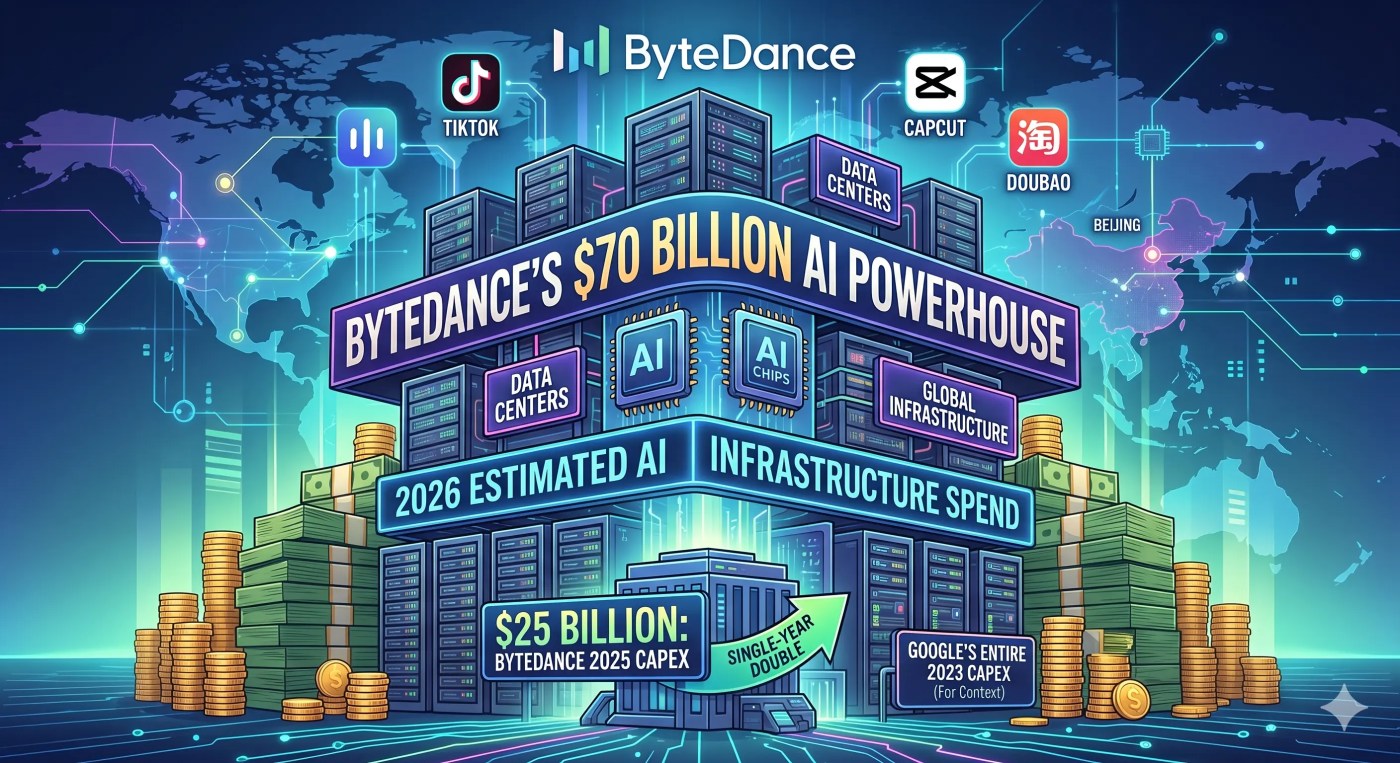
You know TikTok. You’ve probably used CapCut. You might have heard of Doubao. But here’s the thing most people don’t realise: all of these are products of a single company that is now preparing to spend more on AI infrastructure this year than Google’s entire 2023 capital budget.
ByteDance, the Beijing-based tech firm behind TikTok, quietly became one of the most profitable technology companies on earth in 2025. It generated roughly $50 billion in profit. And in 2026, it is discussing using much of that to fund capital expenditures of up to $70 billion, almost all of it pointed at data centers, AI chips, and infrastructure.
That figure is still being worked out internally and could change quarter to quarter depending on chip supply, power costs, and business conditions. But even the floor of the range is staggering. For context, ByteDance spent an estimated $25 billion on capex in 2025. The potential 2026 figure would more than double that in a single year.
Most people outside of China don’t know what ByteDance actually is. They know TikTok. That’s the point of this post.
What ByteDance Actually Is
ByteDance was founded in Beijing in 2012 by Zhang Yiming. It started as a news aggregation app called Toutiao, built around a recommendation algorithm that learned what you’d click on before you knew yourself. That algorithm became the core of everything that came after.
The company now runs more than 60 products serving over 4 billion monthly active users across more than 60 countries. It generated approximately $155 billion in revenue in 2024. It is private, so none of these numbers are officially confirmed, but they’ve been cited consistently across Bloomberg, Reuters, and multiple analyst firms.
Its major products break down like this:
- TikTok: The short-video platform with over 1 billion users globally, banned or restricted in certain markets but dominant across the US, Europe, Southeast Asia, and Latin America
- Douyin: TikTok’s Chinese counterpart, which has grown into a full commerce and livestreaming ecosystem; it generated $483 billion in gross merchandise value in 2024
- CapCut: A video editing app with 200 million monthly active users, now the most-used mobile video editor in the world by a wide margin
- Doubao: China’s most popular AI chatbot, with 345 million monthly active users as of March 2026
- Lark: A workplace productivity platform competing with Slack and Microsoft Teams, primarily across Asian markets
- Volcano Engine: ByteDance’s cloud computing arm, serving enterprise clients and already processing over 1 trillion tokens for external customers
What ties all of these together is the same recommendation engine DNA that started with Toutiao in 2012. ByteDance has always been, at its core, an AI company that happens to run social products. The AI buildout happening now is a natural extension of what the company has always been doing, just at a scale that wasn’t previously imaginable.
The $70 Billion Number and What It Means
The Bloomberg report from May 27, 2026 is the anchor here. According to people with knowledge of ByteDance’s financials, the company is discussing capital expenditures of between 400 billion yuan ($59 billion) and 500 billion yuan ($70 billion) for 2026.
That spending is being directed at:
- Data centers, both inside China and overseas
- AI chips from NVIDIA, Huawei, Cambricon, and now Qualcomm
- Infrastructure to train and serve AI models at consumer scale
- Agentic AI products built on top of Doubao
The Qualcomm piece is worth pausing on. Qualcomm signed a deal to supply ByteDance with millions of AI data center chips, specifically application-specific integrated circuits, to power the company’s AI agent software. This is significant for two reasons. First, Qualcomm’s traditional business is smartphone chips, so a deal of this scale validates its push into the AI data center market. Second, it signals that ByteDance is diversifying its chip sources strategically because US export controls have restricted access to the most powerful NVIDIA GPUs in the Chinese market.
Separately, Reuters reported that ByteDance plans to spend roughly 100 billion yuan (about $14 billion) on NVIDIA chips in 2026, according to the South China Morning Post. That’s alongside Qualcomm and domestic Chinese chips, meaning ByteDance is not putting its infrastructure eggs in a single basket.
If market conditions and chip supply stay favorable, Bloomberg’s sources indicate ByteDance has discussed pushing total capex toward $100 billion in 2027.
One analyst framing that stuck with me: Ke Yan of DZT Research told Bloomberg that “ByteDance, Tencent, and Alibaba are all converging on the view that AI infrastructure is now a strategic asset rather than a discretionary line item.” That’s not an observation about spending. It’s a description of a mindset shift that has no obvious ceiling.
Doubao: The AI Product Most People Outside China Don’t Know About
Doubao (pronounced “Doh-bow”) translates roughly to “bean bun” in Chinese. It’s ByteDance’s AI chatbot and assistant, launched in August 2023, and it has grown faster than any competing AI application in China.
By March 2026, Doubao had 345 million monthly active users, making it China’s most widely used AI application by a significant margin. For comparison, ChatGPT had roughly 600 million monthly users globally as of early 2026. Doubao is doing that kind of number in a single country, with almost no English-first marketing.
The scale is visible in the infrastructure numbers too. In December 2024, Doubao was processing over 50 trillion tokens daily, up from 4 trillion the year before. That kind of growth is what forces $70 billion conversations at the board level.
ByteDance released Doubao 2.0 in February 2026, built on its Seed 2.0 architecture. The new version is designed for what the company calls the “Agent Era”: AI that can plan, reason, and execute multi-step tasks autonomously, not just respond to questions.
Perhaps the most telling signal of Doubao’s momentum: ByteDance is now introducing paid subscriptions. The standard tier is priced at 68 yuan ($10) per month, with enhanced and professional tiers at higher price points. In a Chinese market where nearly every digital service has historically been free, charging users is a significant strategic bet. And given that no other domestic AI app has succeeded with subscriptions yet, ByteDance is essentially testing new ground.
Internationally, Doubao operates under the name Dola (previously Cici) in select overseas markets. Global expansion is clearly a long-term intention, though the primary product experience is still optimised for Chinese users.
CapCut Is Already Everywhere and Getting More AI-Native
If Doubao is ByteDance’s AI bet on the chatbot market, CapCut is its bet on creative tools. And it is working in a way that deserves its own spotlight.
CapCut now has 200 million monthly active users globally. It commands 81% market share in mobile video editing. It is, by those numbers, the most dominant video editing app in the world across mobile. Adobe and Canva are watching it very carefully.
In March 2026, CapCut launched Video Studio, integrating ByteDance’s Seedance 2.0 AI video generation model directly into the editing timeline. You open CapCut, and generative video is already there. No separate app, no new account. The rollout covered Brazil, Indonesia, Malaysia, Mexico, Philippines, Thailand, and Vietnam. It was briefly paused after Hollywood studios raised intellectual property concerns, which tells you something about how seriously the film industry is taking the output quality.
ByteDance’s video AI is not a side project. Seedance 1.0, its text-to-video model, currently ranks first on Artificial Analysis benchmarks, ahead of Google’s Veo 3 and OpenAI’s Sora. Seedance 2.0 was called the “DeepSeek moment for video generation” when it launched in February 2026.
The integration strategy here is worth noting. CapCut templates make it easy to format content for TikTok. TikTok’s algorithm rewards that content. TikTok’s audience then discovers CapCut through the watermark on the video. It’s a loop that compounds at scale and drives user acquisition at near-zero marginal cost.
The Geopolitical Layer That Doesn’t Go Away
You can’t write about ByteDance honestly without acknowledging the context the company operates in.
TikTok has faced bans, near-bans, data-separation mandates, and continuous legislative scrutiny in the United States. The concern from regulators is about potential Chinese government access to US user data and the influence the recommendation algorithm could have on political discourse. ByteDance created a separate US data infrastructure called Project Texas to address these concerns, but the political environment has remained volatile.
The Qualcomm chip deal captures the tension well. Washington spent years scrutinising TikTok and restricting advanced technology exports to China-linked companies. Yet ByteDance is still sourcing US-designed chips for its AI infrastructure. The gap between national-security rhetoric and commercial reality is very real, and it shows up in deals like this one.
Export controls have forced ByteDance to develop domestic chip alternatives. Its internal team has advanced a chip reportedly comparable to NVIDIA’s H100 in performance for certain workloads. It is also buying from Huawei and Cambricon while simultaneously securing deals with Qualcomm. The chip strategy is geographic diversification as much as it is technical.
The geopolitical pressure has arguably made ByteDance a more self-sufficient company. Every restriction on NVIDIA access accelerated its investment in domestic capability. Every TikTok ban conversation accelerated its investment in building products that don’t depend on any single market.
How This Compares to the US Tech Giants
The numbers become easier to read when you put them alongside US counterparts:
- Microsoft announced plans to spend $80 billion on AI infrastructure in fiscal year 2025
- Google’s parent Alphabet committed to approximately $75 billion in capex for 2025
- Meta announced $60 to $65 billion in capex for 2025
- Amazon is spending over $100 billion on AI and cloud infrastructure across 2025 and 2026
ByteDance at $70 billion puts it squarely in that conversation. What makes it different is that unlike the US hyperscalers, ByteDance is a private company with no shareholder pressure to justify every dollar to analysts. It is also funding a significant portion of this spending from profit rather than debt or equity raises, which is a different kind of confidence altogether.
DZT Research analyst Ke Yan made the point that the gap between Chinese and US tech firms may be smaller than it appears, once the lower cost of building data centers in China is factored in. ByteDance may be able to build equivalent computing capacity for meaningfully less than what Amazon or Microsoft spend on the same number of servers in the US or Europe.
Tencent has committed to at least doubling its AI investments to more than 36 billion yuan ($5.3 billion) this year. Alibaba is on a rolling $50 billion target over three years. Goldman Sachs estimated that China’s top internet firms will collectively spend $70 billion on AI infrastructure in 2026. ByteDance alone could match that entire figure.
What ByteDance Is Actually Building Toward
The infrastructure buildout is not an end in itself. It’s what the infrastructure enables that matters.
Doubao’s shift toward agentic AI is the clearest signal of direction. Agents don’t just answer questions, they take actions: booking things, drafting content, running workflows, interacting with other apps. That kind of system requires a lot more compute than a chatbot that responds to text prompts. ByteDance is building the compute before the demand fully arrives, which is the classic infrastructure playbook used by AWS in the early cloud era.
Volcano Engine, its cloud arm, is quietly becoming a real enterprise business. It has over 100 enterprise clients processing more than 1 trillion tokens combined. It powered China Central Television’s Spring Festival Gala, the most-watched broadcast event in the country. As Doubao grows, more of that enterprise demand funnels through Volcano Engine, which starts to look like a competitive cloud platform rather than just an internal tool.
Hardware is part of the picture too. The Doubao Phone, a ZTE Nubia device launched in December 2025, gives the Doubao AI assistant screen-level access to all apps running on the phone, including banking apps. That is a different kind of ambient computing product. It is also the kind of product that would face serious regulatory scrutiny outside China, which may be why ByteDance hasn’t pushed it globally yet.
The global product roadmap is still being revealed one launch at a time. But the direction is clear: ByteDance wants Doubao to be to China what ChatGPT is to the rest of the world, and it wants CapCut to be the AI-native creative tool for everyone else.
Why This Matters for You, Wherever You Are
If you are a content creator, CapCut’s AI features are already available in your market and are getting significantly more powerful this year. Ignore them and you’ll eventually notice that everyone else’s videos look different.
If you work in tech or product, ByteDance’s infrastructure approach is worth studying. The company has never separated its recommendation AI from its product development. AI is not layered on top of TikTok or CapCut, it is what those products are made of. That integration is an advantage that took years to build and is hard to replicate quickly.
If you are watching the AI industry more broadly, ByteDance is now one of the clearest proof points that the AI race is genuinely global. It is not a US story. It is not a China story. It is a race between organisations with massive user bases, deep pockets, and genuine technical capability, and ByteDance qualifies on all three counts.
The company behind TikTok is also the company spending $70 billion this year to build an AI empire. Those two facts don’t contradict each other. They’re the same fact, seen from different angles.
The AI race doesn’t have a single front, and the company everyone thinks they know turns out to be one of its most serious players.


Leave a Reply