
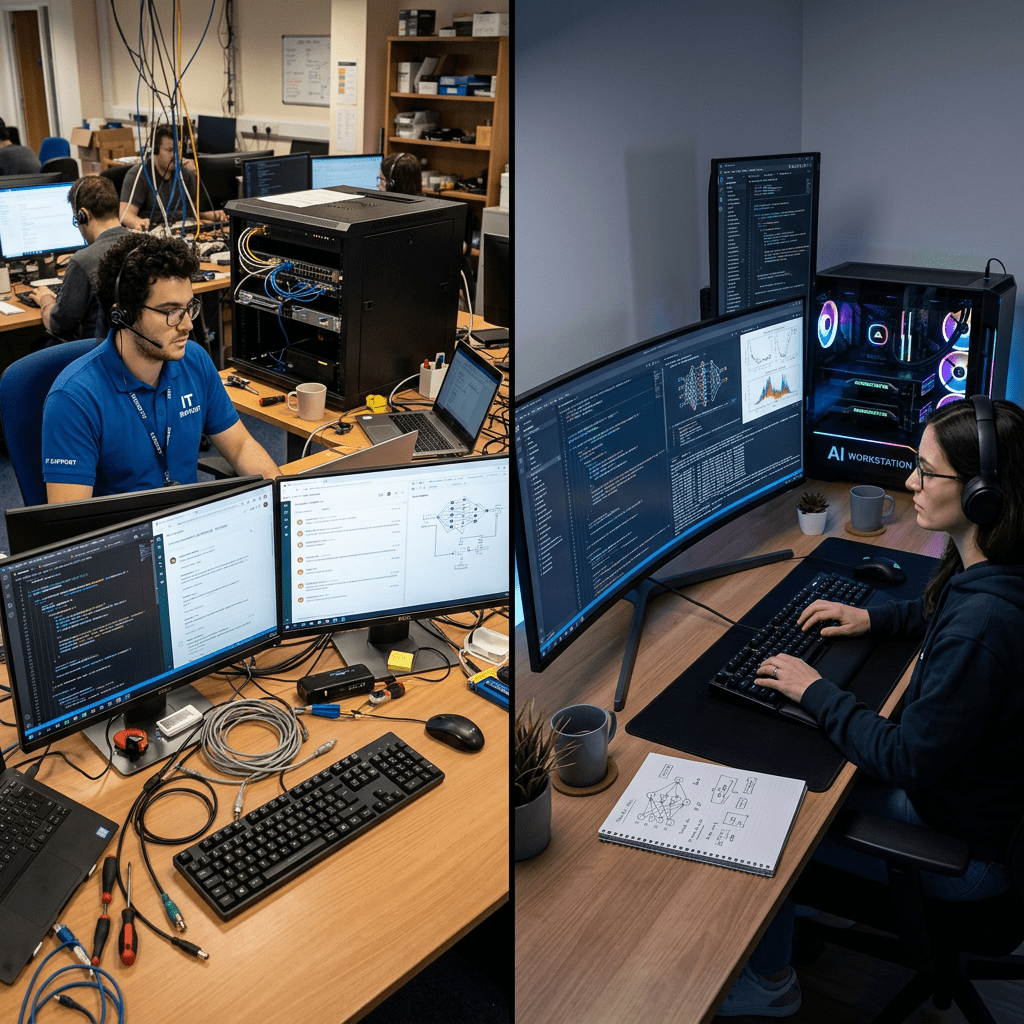
Open General Motors’ careers page. Scroll past the job titles you recognise. Look at what they are actually hiring for this week.
If you have spent the last fifteen years inside an IT department, you just felt the ground shift under your feet.
On May 11, 2026, GM laid off about 600 IT workers, roughly 10% of its information technology team. The cuts hit Austin, Texas and Warren, Michigan. The same week, GM kept posting jobs. Just for very different skills. AI-native development. Data engineering. Cloud architecture. Agent and model development. Prompt engineering for production. New AI workflows.1, 2
This is not a layoff. It is a skills swap. And it tells you exactly where every large tech employer is headed in the next eighteen months.
This Is Not Just GM. It Is Almost Everywhere.
Look at the last six months and the pattern stops being subtle.
- Atlassian cut 1,600 roles in March 2026 and announced 800 new AI-focused hires in the same restructuring.4
- Freshworks laid off 11% of staff (about 500 people) on May 5, 2026, after its CEO acknowledged that more than half the company’s code is now written by AI.6
- Coinbase laid off 700 employees (14% of staff) in May 2026 to make the business more AI-native, per CEO Brian Armstrong.4
- Accenture announced 11,000 cuts in December 2025. CEO Julie Sweet was blunt about the logic: “Those we cannot reskill will be exited.”4
- Block, under Jack Dorsey, slashed headcount from 10,000 to fewer than 6,000 in February 2026, attributed directly to AI in the shareholder letter.4
The aggregate is brutal. Around 78,557 tech workers were laid off between January and April 2026 alone. Nikkei Asia attributes 47.9% of those cuts directly to AI and workflow automation.3 By mid-April, more than 150,000 tech jobs had been eliminated across over 500 companies, with the pace accelerating month over month.5
The companies doing this are not shrinking. Many are spending record amounts on AI infrastructure. They are reshaping the workforce around AI capability. The headcount is moving, not disappearing.
The Real Dividing Line: Building With AI vs Using AI
Here is the thing most career advice keeps missing.
There is now a clean separation between using AI as a productivity tool (which any knowledge worker can pick up after a weekend of YouTube) and building with AI from the ground up. GM’s hiring list draws that line plainly:1
- AI-native development. Engineers who design products around AI from the first line of code.
- Data engineering and analytics. People who build the pipelines AI models actually need to run on.
- Cloud-based engineering. Distributed systems that can serve AI at scale without falling over.
- Agent and model development. Teams who design autonomous workflows that hand off tasks between AI and humans.
- Prompt engineering for production. Not the kind that goes viral on Twitter. The kind that builds evaluations, guardrails, and reliability into shipped products.
If your day job is mostly using ChatGPT to summarise documents or write emails faster, you are on the wrong side of that line.
This does not mean you are doomed. It means the bar is now visible. You can choose to cross it.
The Skills That Get You Hired in 2026
Demand for these skills is not theoretical. The pay tells the story.
Lightcast analysed over a billion job postings and found that roles listing at least two AI skills pay 43% more than comparable roles without them.7 PwC’s Global AI Jobs Barometer puts the wage premium for workers with high-demand AI skills at 56%.7 Job listings for prompt engineering alone grew 135.8% in 2025.8
Here is the short version of where to invest your time, drawn from the same datasets every serious analyst is now using:
| Skill cluster | What it actually means | Where to start (free or cheap) |
|---|---|---|
| AI-native development | Building products with AI at the core, not bolted on later | Anthropic Claude API docs, OpenAI Cookbook |
| Data engineering | Pipelines, warehouses, vector databases | dbt fundamentals, BigQuery or Snowflake basics |
| MLOps | Deploying, monitoring, and updating models in production | Made With ML, Coursera MLOps Specialisation |
| Prompt engineering for production | Eval frameworks, agent architectures, guardrails | Anthropic prompt engineering guide, DeepLearning.AI |
| LLM fine-tuning | Customising open models on your own data | Hugging Face course, Lightning AI tutorials |
| Agentic AI | Multi-step autonomous workflows with tools | LangChain, LlamaIndex, CrewAI docs |
You do not need all six. Pick one cluster that overlaps with what you already know. A network engineer should pivot toward cloud and data infrastructure. A QA engineer should look at evals and reliability. A junior developer should pick MLOps or agentic AI. Domain knowledge plus AI skill is the combination that pays. Pure prompt engineering with no industry context is now harder to place, not easier.9
What This Means for Indian Tech Workers
Two facts that should not coexist in the same paragraph, but do.
NASSCOM reports that India ranks number one globally in AI skill penetration and holds the world’s second-largest AI and ML talent pool. India also leads global enrolment in generative AI courses on Coursera. Yet the same analysis estimates India still needs over one million additional AI-skilled professionals to meet existing demand.9
For the IT professional sitting in Bangalore, Pune, Hyderabad, or Gurgaon, this is the strangest moment to be in the market. Service companies are restructuring large parts of their delivery model around AI services. The same firms are racing to hire AI engineers and offering wage premiums of up to 56% for the right skill mix.7
The opportunity is real. The window to cross the dividing line is wider for people with three to ten years of IT experience than it is for fresh graduates, because domain context plus AI skill is the actual unlock.
Four Things to Do This Week
1. Run a Brutal Skill Audit on Yourself (30 minutes)
Open a doc. List everything you do at work in a typical week. Label each task with one of three buckets:
- AI can do this fully today
- AI can do this with my supervision
- AI cannot do this yet
If most of your week falls in bucket one or two, you have your answer. Your role is on the wrong side of the line. You need to start moving today, not next quarter.
2. Pick One Skill Cluster and Commit Sixty Days
Do not try to learn everything at once. Pick one column from the table above. Set a sixty-day goal that ends with something tangible: a deployed project, a working agent, a fine-tuned model, or a public write-up of a real internal use case.
A few starter routes that are free or close to free:
- DeepLearning.AI Short Courses (around an hour each, all hands-on)
- Anthropic’s prompt engineering tutorial
- OpenAI Academy (I wrote a full guide to it on this blog last week)
- Hugging Face’s free LLM course
- Kaggle Learn for data engineering and ML fundamentals
3. Build a Public Portfolio of AI Work
A LinkedIn post that says you are “passionate about AI” is worth nothing in 2026. A GitHub repo with a working agent, a Hugging Face Space, a published fine-tune, or a write-up of how you shipped something useful is worth a lot. Pick one shippable thing every two weeks. Make it public. Tag it well. Hiring managers screen by evidence now, not adjectives.
4. Watch Your Own Employer’s Job Listings
This is the most actionable signal in this whole article. Open your employer’s careers page once a week. Note three things:
- What new roles are appearing that did not exist six months ago?
- Which older roles are no longer being backfilled?
- Which job descriptions have suddenly added “experience with LLMs” or “AI workflow design” as a requirement?
Your own company is quietly telling you exactly which skills will matter inside the building twelve months from now. Listen.
The Honest Caveat: How Much of This Is Actually Real?
Not every 2026 layoff is genuinely about AI.
OpenAI’s Sam Altman said the quiet part out loud at the India AI Impact Summit, acknowledging that there is “some AI washing where people are blaming AI for layoffs” that would have happened anyway.3 Cognizant’s Chief AI Officer Babak Hodjat told Nikkei that AI sometimes becomes a financial scapegoat when companies are correcting pandemic-era overhiring.3
Some of the 2026 cuts are correcting that overhiring binge. Some are pre-emptive cost reductions to fund expensive AI infrastructure. Some are genuine workflow automation reducing real headcount needs.
The caveat does not change the direction of travel. It just means the headlines are noisier than the underlying trend. The underlying trend is real, and the companies hiring most aggressively are not advertising “expert ChatGPT user” as a qualification.
The Bottom Line
GM is not the first large employer to do this swap. It is just the cleanest public example so far of treating AI capability as a workforce-replacement strategy, not a tool upgrade.
The signal under the noise is consistent. Companies are not getting rid of IT teams. They are getting rid of IT teams that cannot build with AI. The new dividing line runs between people who design systems around AI and people who only use AI as a faster typewriter.
Run the audit. Pick the skill cluster. Build something public. Watch your own employer’s careers page. None of this is glamorous. All of it is how you stay employed while this quiet swap continues in every IT department through 2026 and 2027.
If you are still figuring out which side of the line you are on, send this to your team and run the audit together this week.
Sources and further reading
- TechCrunch, GM just laid off hundreds of IT workers to hire those with stronger AI skills (May 11, 2026).
- Tech Startups, General Motors lays off hundreds of tech workers amid AI push and software overhaul (May 11, 2026).
- Tom’s Hardware, Tech industry lays off nearly 80,000 employees in Q1 2026, almost 50% of affected positions cut due to AI (April 8, 2026).
- Programs.com, List of Companies Announcing AI-Driven Layoffs.
- Tech Insider, 150K+ Tech Jobs Cut in 2026, Who’s Next? (April 2026).
- The Workers Rights, Freshworks Layoffs 2026: AI Code Replacing Tech Jobs (May 2026).
- Curominds, 15 High-Demand AI Skills Employers Are Paying 43% More For in 2026.
- Second Talent, Top 10 Most In-Demand AI Engineering Skills and Salary Ranges in 2026.
- SkillUpgradeHub, AI Skills Career Guide 2026: Complete Career & Salary Guide.


Leave a Reply